
Whether you’re a medical doctor or a chiropractor like me, we can’t ignore mental health anymore. With all the SG60 hype, it feels very appropriate to take the time to consider what is the next step for our people as a society.
There is no doubt my generation (i.e., millennials) are enjoying the fruits of the labour of those who came before us. We are living in a first world country not because of our own efforts but the people who came before us. We have one of the best, if not the best, healthcare systems in the world. Both life expectancy and health span are also the top in the world.
I mean, what’s the point of all these if we are not happy as a society? Yes, we have prospered and flourished economically. But what now?
Singapore got it Good, but are we happy?
Our parents and grandparents left everything behind. They came to Singapore for a better life. They toiled hard to give us opportunities they never had.
Because of their sacrifice, we got incredible perks. One of the world’s best healthcare systems, top-notch life expectancy, economic prosperity, low unemployment, high GDP per capita, etc.
But here’s the big question – what’s next?
Is it just more hard work? More economic growth? No. We need to dig deeper into mental health and happiness.
How is it that despite having so much in our favour, we’re still struggling with happiness? A 2012 Gallup poll found Singaporeans were the least likely in the world to experience positive emotions. We ranked even lower than war-torn countries like Iraq and Afghanistan! Only 36% of us reported feeling any emotions at all.
That was over a decade ago, we have made progress but not enough. In 2024, Singapore ranked 34th globally in the World Happiness Report. This puts us behind the nordic countries, Australia, Canada, United Kingdom, and United States. The countries ranked after us were Romania (35th), Brazil (36th), and El Salvador (37th).
Mental health has made progress in Singapore
Don’t get me wrong, we are certainly moving in the right direction. The suicide decriminalisation in January 2020 was huge. It’s about acknowledging and treating mental health issues as actual health problems. Not crimes.
When suicide was illegal, it created stigma. It told people they should be ashamed. It stopped them getting help because they feared legal trouble.
These attitudes and beliefs stick for a long time. Five years after suicide has been decriminalised, many people in Singapore still don’t know this change. People still think the police are involved for suicide cases. There are still people who think that unsuccessful suicide attempts land you in land.
This is just not true.
Launch of national mental health hotline in June 2025
In June 2025, Singapore launched a national mental health hotline. We already had Samaritans of Singapore (SOS) running a 24/7 hotline. So why’s this different?
The biggest difference is that the national service uses trained counsellors. A total of 30 full-time counsellors operate the hotline. SOS, on the other hand, relies on trained volunteers. However, these volunteers do not have clinical training or practicum hours compared to those of counsellors.
Don’t get me wrong though. SOS still does brilliant work. According to their website, SOS intervenes and prevents 1 suicide every 26 hours. They pioneered crisis support in Singapore. In 2020, they piloted CareText, which is a WhatsApp support service for those who prefer to text rather than call. The service initially had limited operating hours but was subsequently converted to a 24/7 service.
But a national service? That shows our government’s serious about mental wellness. The scale and expertise they can offer is game-changing.
Mental health is still a problem in Singapore
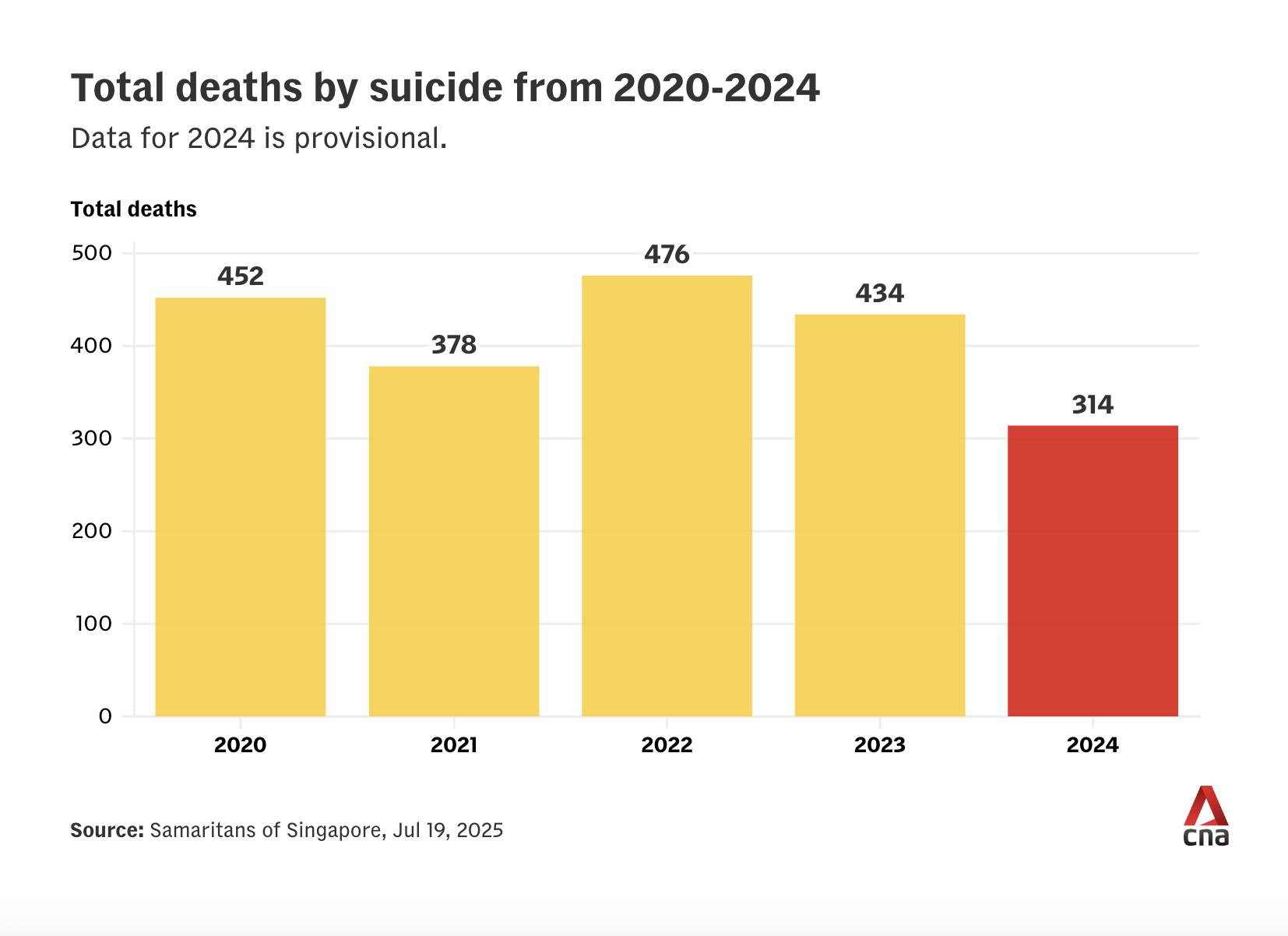
Last year, there were 314 deaths by suicide. That is 314 too many deaths. I don’t know what are the figure for attempted suicide, and if any organisation does track them.
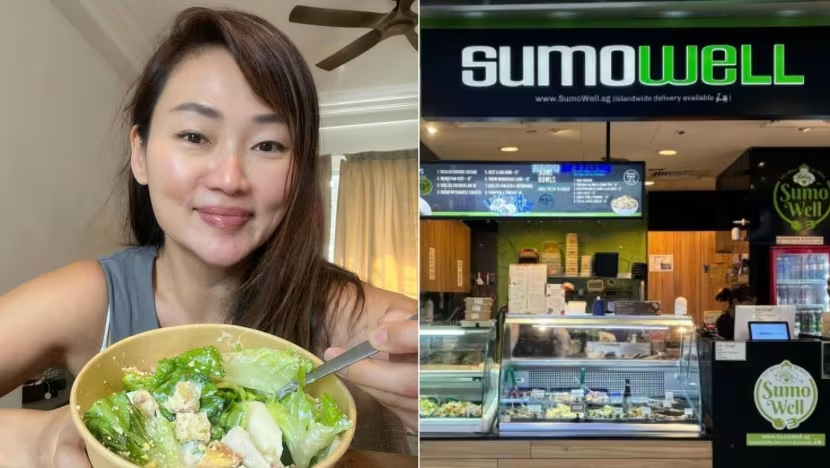
The most recent case in the media was the death of Jane Lee, the founder of Sumo Salad. She left a public Facebook post to suggest that an employee who allegedly faked a workplace injury may have contributed to her suicide.
Ministry of Manpower later reported that Jane in the Sumo Salad case was fully reimbursed by insurer. The initial assumption from the public was that perhaps there was some issues with the claim, and that Jane might be having financial difficulties with the claim. With the latest update from MOM, it seems like the issue is more complex.
Of course it is! Mental health challenges are almost always multifactorial in nature. It is never about money alone or whatever alone. In the case of Jane, even though her case seems to largely revolve around compensation fraud, MOM’s report would suggest that the issue is not just about money alone.
Kpods: Youths are not spared
Vaping, even etomidate-laced Kpods, is becoming a big problem in Singapore now. They have become more readily accessible despite strict regulations. Reports have suggested that Kpods are sold outside primary schools. The problem, however, is not just Kpods alone.
Healthy individuals don’t just turn to substance abuse. And by healthy, I mean mentally and socially, not just physically. There must be underlying factors making young people vulnerable.
What drives a 12-year-old to pick up a vape? Is it peer pressure? Is it escape?
Mental health challenges among youths and younger adults
A recent study by the Institute of Mental Health found that nearly one in three young people aged 15 to 35 in Singapore reported symptoms that included feeling empty, tense or upset most of the time. That’s according to Singapore’s first nationwide survey on youth mental health.
The National Youth Mental Health Study revealed that 30.6% of individuals aged 15-35 experience severe symptoms of depression, anxiety, or stress. Even more concerning? Parents recognise clinical-level symptoms in their children only 10% of the time.
These aren’t just statistics. These are our kids, our siblings, our friends.
Associate Professor Swapna Verma from IMH noted that social media exposes young people to constant comparisons, intensifying concerns about body image. The study found that 27% show signs of excessive social media use, with 21% reporting cyberbullying experiences.
They see curated highlight reels and think their behind-the-scenes struggles are unique. This breeds isolation and inadequacy.
Vaping becomes part of fitting in. Looking cool. Being part of the group.
Even athletes are not spared
The mental health crisis doesn’t spare anyone. Not even our nation’s best athletes. A recent study reported that Singapore’s national athletes experience significant levels of poor mental health, despite their physical prowess and success. Sport Singapore has recognised this, adding well-being surveys to regular medical check-ups since 2020 to screen for psychological distress, including eating and sleeping disorders.
Mental health challenges can affect anyone. Regardless of how physically fit or successful they appear on social media, they is more than what we can see. Our athletes face unique pressures: intense training schedules, performance expectations, and public scrutiny.
When they struggle, it reminds us that mental wellness isn’t about being “weak” or “strong” – it’s about being human. The good news is that initiatives like Sport Singapore’s proactive screening show we’re moving in the right direction, treating mental health with the same importance as physical health.
Moving forward: What can we do?
I mean, majulah right? Singapore is all about progress and moving forwards. Our national anthem was composed by Zubir Said in 1958 but is still ever relevant today.
Singapore’s come a long way. We’ve decriminalised suicide. We’ve launched a national mental health hotline. We’re the happiest country in Asia.
But we can’t stop here.
Individuals: We the people of Singapore?
One people, one nation, one Singapore, right?
Even on an individual level, there is much we can do to promote mental health. The simplest could start with just checking in with your mates. It could be a simple question to ask about their work or even something more directed at how they are feeling.
If you’re struggling yourself, reach out. I get that sometimes our friends are not available. This happens to me a lot. Thankfully, we do have helplines available 24/7 for you to get help. There is still the stigma of course. It does take courage to make the call.. I do appreciate that it can be challenging but I think you should anyways. It’s a start.
SG70? SG80? … SG100?
Bring on the GST vouchers and CDC vouchers! On a more serious note, we have built an incredible nation. Our parents and grandparents gave us economic prosperity and world-class systems.
Now it’s our turn to build something they couldn’t measure in GDP: a society where people genuinely thrive, not just survive.
SG60 shouldn’t be just about celebrating what we’ve achieved. It’s about deciding what comes next.
The next chapter isn’t about working even harder or growing even faster. It should also be about being happier, healthier, and more connected as a society.
Our parents sacrificed for our success. Let’s not sacrifice our wellbeing for the next generation’s.
Let’s build the happiness.
BOOK A CHIROPRACTOR IN SINGAPORE
Based in Singapore, Square One Active Recovery offers treatments with a very big difference. With our evidence-based exercise approach, you can achieve your recovery goals in just 12 weeks. Not getting results from your chiropractor, TCM doctor or physiotherapist? Talk to us and find out how we can take your recovery to the next level.
Our goal? To make our own services redundant to you.
*We do not offer temporary pain relief such as chiropractic adjustments, dry needling, or any form of soft tissue therapy.

