
Clinical Insight
Neck Pain After Headstands: Causes, Risks & Safe Alternatives
Experiencing neck discomfort, tingling, or pain after practising headstands in yoga? You are not alone, and your symptoms are a warning sign that should not be ignored.
At Square One Active Recovery, we regularly see yoga practitioners with headstand-related cervical spine injuries. This page explains why headstands pose unique biomechanical risks to your neck, how to recognise warning signs of tissue damage, and what safer alternatives exist to build true upper-body strength without compromising your long-term spinal health.
If you are currently experiencing neck pain, radiating arm symptoms, or loss of grip strength after inversions, we can help identify the root cause and create a personalised recovery plan.
Are You Experiencing Headstand-Related Neck Pain?
Common symptoms that indicate cervical spine stress from headstands include the following changes.
Immediate warning signs during or right after practice
- • Sharp pain at the base of the skull or upper neck
- • Feeling of pressure or heaviness in the cervical spine
- • Muscle tightness that does not resolve with stretching
- • Difficulty turning your head side to side
Delayed symptoms hours to days after practice
- • Persistent stiffness in the neck that worsens over 24 to 48 hours
- • Dull aching pain that radiates into the shoulders
- • Headaches originating from the base of the skull
- • Increased pain when looking up or holding your head in one position
Serious neurological symptoms seek immediate assessment
- ✔ Sharp electric or shooting pain radiating down your arm
- ✔ Numbness or pins and needles in your hands or fingers
- ✔ Weakness in grip strength or difficulty holding objects
- ✔ Tingling sensations that track into your face or scalp
If you are experiencing any symptoms in this third category then these indicate potential nerve root compression and require professional assessment. Even mild symptoms in the first two categories warrant attention because they are your body early warning system signalling tissue distress.
Why Do People Practice Headstands?
The headstand (Sirsasana) has deep historical roots in centuries-old Hatha Yoga. Traditionally, inversions were not viewed merely as physical exercises but as energetic tools. Ancient yogic texts described a vital nectar called Amrita, associated with youth and longevity, stored in the brain but constantly dripping downward into the digestive fire of the torso where it would be destroyed. Inversions were practiced to literally reverse gravity, preserving this nectar in the head to promote vitality.
Today, however, people gravitate toward inversions for different reasons. Inversions have become a visible indicator of athleticism and aesthetic achievement. They require strength and balance, and look impressive on social media. The headstand, particularly, is celebrated as a milestone achievement in many yoga communities.
Why headstands feel “easier” than other inversions:
The headstand provides a wider, more stable tripod base of support as your weight is distributed through both forearms and the skull. This demands significantly less balance and shoulder mobility than a handstand or elbow stand.
For many practitioners, this makes the headstand an attractive shortcut to achieve the aesthetic of being upside down without first building the necessary upper-body strength.
The flawed logic:
If you lack the shoulder girdle stability and weight-bearing capacity to keep your body weight entirely off the floor, resting your weight on your head does make the pose feel immediately accessible. However, using the skull as a kickstand to bypass physical weakness comes at a significant cost to your neck. You’re trading potential cervical spine injury for a short-term sense of achievement.
The Biomechanics: Why Your Neck Is Not Built for This
The Physics of Cervical Compression
Your cervical spine is a highly specialised and delicate structure designed primarily to support the weight of your head which is approximately 4.5 to 5.5 kg. It has evolved to allow for an incredible range of motion so you can turn tilt and rotate your neck to scan your environment with remarkable freedom. This mobility comes at a cost because the cervical spine was never evolutionarily intended to act as a primary weight bearing pillar for your entire body mass.
What happens during a headstand
When you perform a headstand you subject these small vertebrae and shock absorbing discs to direct axial loading they are simply not built to handle. Instead of managing a 5kg load the neck suddenly becomes the foundation supporting a significant portion of your body weight.
Even with proper technique and shoulder engagement substantial axial load remains concentrated on the cervical spine. Because the cervical spine lacks the robust structural mass and dense bone architecture of the lower back this vertical pressure forces delicate tissues to cope with extreme mechanical overload.
The Vulnerability of Cervical Facet Joints
The facet joints in your neck are planar gliding synovial joints. Their primary function is to allow the vertebrae to glide smoothly over one another so you can look around freely. Unlike the hinge like structure of your elbow or the ball and socket design of your hip, there is nothing inherent in the structure of these flat joints to stop excessive movement or lock the spine into a rigid weight bearing column.
When you force these gliding surfaces to compress under body weight during a headstand, you rely entirely on small deep neck muscles to prevent the joints from slipping out of alignment. These muscles, the suboccipitals multifidus and cervical erector spinae, are designed for precision control and postural stability, not for sustaining heavy loads.
The result
Biomechanical studies on spinal loading patterns indicate that excessive vertical compression forces the cervical vertebrae together, leading directly to facet joint irritation. These facet joints are heavily innervated with pain receptors. When compressed repeatedly, they become inflamed, resulting in localised sharp neck pain and protective muscle guarding or spasm.
Clinical Consequences: How Headstands Damage Your Neck
Disc Integrity and Degeneration
Beyond joint inflammation, structural overload poses a serious threat to your intervertebral disc health. The cervical discs are designed to distribute hydrostatic pressure and absorb minor shocks during upright movement. Under the substantial axial load of an inversion, the pressure inside the nucleus pulposus, the gel like centre of the disc, rises dramatically.
Research on spinal biomechanics shows that this localised pressure increase can cause the outer rings of the disc, the annulus fibrosus, to fray or tear. This allows the inner material to bulge outwards. Over time, repetitive exposure to this specific type of compression compromises the hydration and overall height of the discs.
The cumulative effect
This microtrauma accelerates degenerative disc changes, resulting in
- • Chronic stiffness and reduced neck mobility
- • Permanent loss of segmental movement
- • Increased susceptibility to future injury
- • Long term functional impairment that impacts daily activities
Important distinction Acute injury from a single headstand is relatively rare. The primary concern is cumulative loading over months and years, especially for those with pre existing neck issues, forward head posture from desk work, or inadequate technique.
Nerve Root Compression: The Nerve Highway
The cervical spine serves as the primary gateway for the complex neural network controlling your upper extremities. The nerve roots that branch directly off the spinal cord must exit the spinal column through narrow bony openings called the intervertebral foramina.
When a headstand forces the neck into direct axial compression, these foraminal spaces constrict significantly. Biomechanical literature on cervical radiculopathy confirms that reducing this space leads to mechanical compression or chemical irritation of the nerve roots.
When these neural pathways are compromised, three primary clinical symptoms emerge
1. Radiculopathy
This occurs when a compressed nerve root triggers abnormal nerve discharges. You experience this as sharp electrical or shooting pain that radiates from the neck down through the shoulder and into the arm or hand. The pain typically follows a specific pathway corresponding to which nerve root is affected.
2. Paresthesia
Mechanical pressure on the sensory fibers of the nerve roots interrupts normal signaling. This manifests as
- • Localised numbness or loss of tactile sensitivity
- • Persistent pins and needles tingling sensation
- • Abnormal sensations that can affect the hands fingers or even track upwards into the face and scalp
3. Motor Weakness
When the motor fibers within the nerve root are compressed, nerve conduction to the target muscles is disrupted. This causes
- • Sudden measurable drop in grip strength
- • Loss of wrist stability or coordination
- • Feeling of arm fatigue or heaviness
- • Difficulty with fine motor tasks like typing writing or holding utensils
These symptoms indicate that the neural drive required to activate upper limb muscles is being mechanically blocked at the neck level.
Vascular Vulnerability: The Vertebral Artery and Stroke Risk
Beyond joints, discs, and nerves, the headstand introduces a severe and potentially life altering hazard to your vascular system. The vertebral arteries travel upwards through the neck, passing inside small bony channels within the vertebrae. Crucially, as the vertebral artery reaches the very top of the cervical spine, it must exit the C2 vertebra and execute a sharp, dramatic looping kink around the C1 atlas vertebra to enter the base of the skull.
This natural structural loop is highly vulnerable to mechanical trauma. When you perform a headstand, you place the neck under substantial compression forces whilst simultaneously risking sudden hyperextension, rotation, or micro movements if balance is lost. If your body weight shifts or you wobble and fall out of the inversion, the sudden traction and twisting forces applied to this loop can easily tear the delicate inner lining of the blood vessel.
The reality of arterial dissection
A tear in this inner lining is known medically as a vertebral artery dissection. When a dissection occurs, blood enters the wall of the artery, forming a clot that can occlude the vessel entirely or break free and travel straight to the brain. Neurological literature and clinical journals contain multiple documented reports of ischemic strokes directly triggered by yoga headstands.
Whilst these vascular catastrophic events are statistically rare, they represent an extremely real, high stakes risk. Unlike muscular fatigue or localised joint inflammation, a vertebral artery injury carries permanent, neurological consequences. Given that you can achieve every single physiological benefit of an inversion utilising safer alternatives that entirely unload the cervical spine, exposing your vascular system to this type of mechanical vulnerability is simply not worth the risk.
Who Is Most at Risk?
While experienced yoga practitioners with exceptional cervical conditioning, robust thoracic mobility, and highly developed scapular stability may tolerate headstands for years without apparent issues, it is unwise to assume that the average person’s neck can withstand the same level of stress.
High-risk populations:
Office workers and desk-based professionals
Modern lifestyle often involves hours of sedentary work, forward head posture, and minimal overhead strength training. In Singapore, neck pain is exceedingly prevalent and affects up to 23% of the population. Many of our cervical spines are simply not prepared for the intense loading of a headstand!
Beginners to intermediate yoga practitioners
Those who haven’t yet developed the shoulder girdle strength to perform an elbow stand or handstand are precisely the people most likely to use the headstand as a shortcut—and most likely to experience injury.
Individuals with pre-existing conditions
- • Prior neck injuries (whiplash, sports trauma)
- • Degenerative disc disease or cervical spondylosis
- • Chronic forward head posture
- • History of cervical radiculopathy or nerve compression
- • Hypermobility syndromes
People with inadequate progression
Those who attempt inversions without first building adequate:
- • Scapular stability and control
- • Thoracic spine extension mobility
- • Core strength for proper spinal alignment
- • Shoulder flexion strength and endurance
Your neck is fundamentally not a weight-bearing joint. Relying on the hope that your spine can tolerate an unnatural mechanical demand is a high-risk strategy, especially when safer and more sustainable alternatives exist.
Safe Alternatives Building True Upper Body Resilience
If your goal is to experience the benefits of an inversion, the solution is to shift the load away from the delicate bones of your neck and onto structures that are actually built to manage mechanical stress.
Stroke Risk
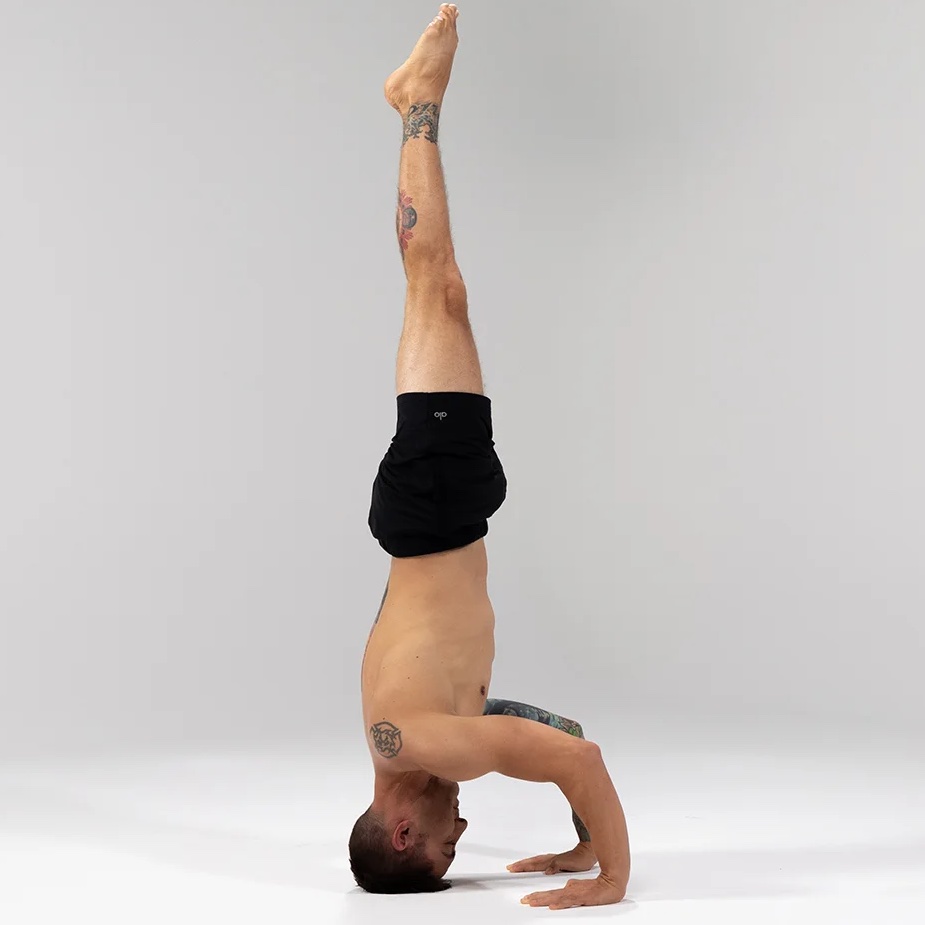
Headstand
(Sirsasana)
- ❌ Highly mobile and structurally unstable cervical joints that are simply not designed to weight bear.
- ❌ Facet joints in the neck function as gliding joints which are inherently unstable under vertical pressure.
- ❌ Vertebral arteries pass through narrow foramina transversaria making them highly susceptible to tearing during falls.
- ❌ Relies dangerously on small deep neck muscles like the suboccipitals multifidus and cervical erector spinae.
- ❌ These deep muscular structures are anatomically built for precision control and postural stability not for heavy loading.
Hinge Joint Stability
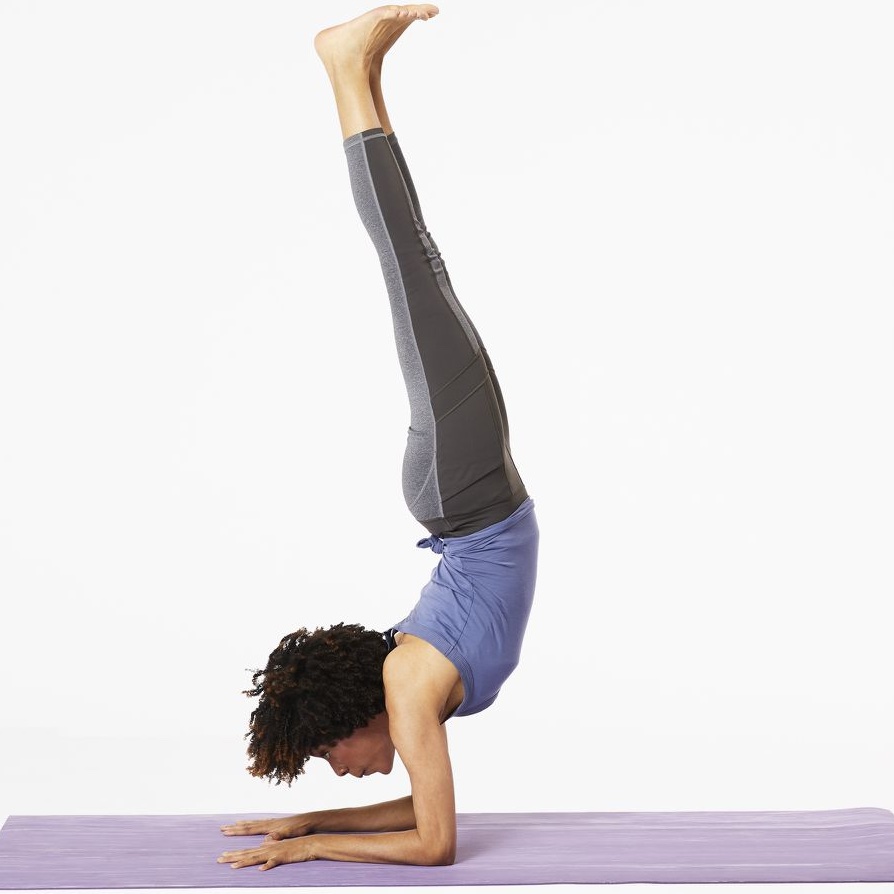
Elbow Stand
(Pincha Mayurasana)
- ✅ Primary base of support shifts completely to the structurally robust elbow complex.
- ✅ Highly stable under load because the elbow is a hinge joint that restricts movement to a single plane.
- ✅ Full forearm contact with the ground creates a significantly wider and safer structural base.
- ✅ Features a naturally resilient bony architecture built to withstand strong environmental forces.
- ✅ Backed by strong ligamentous support that easily tolerates axial loading with minimal risk of buckling.
Muscular Strength
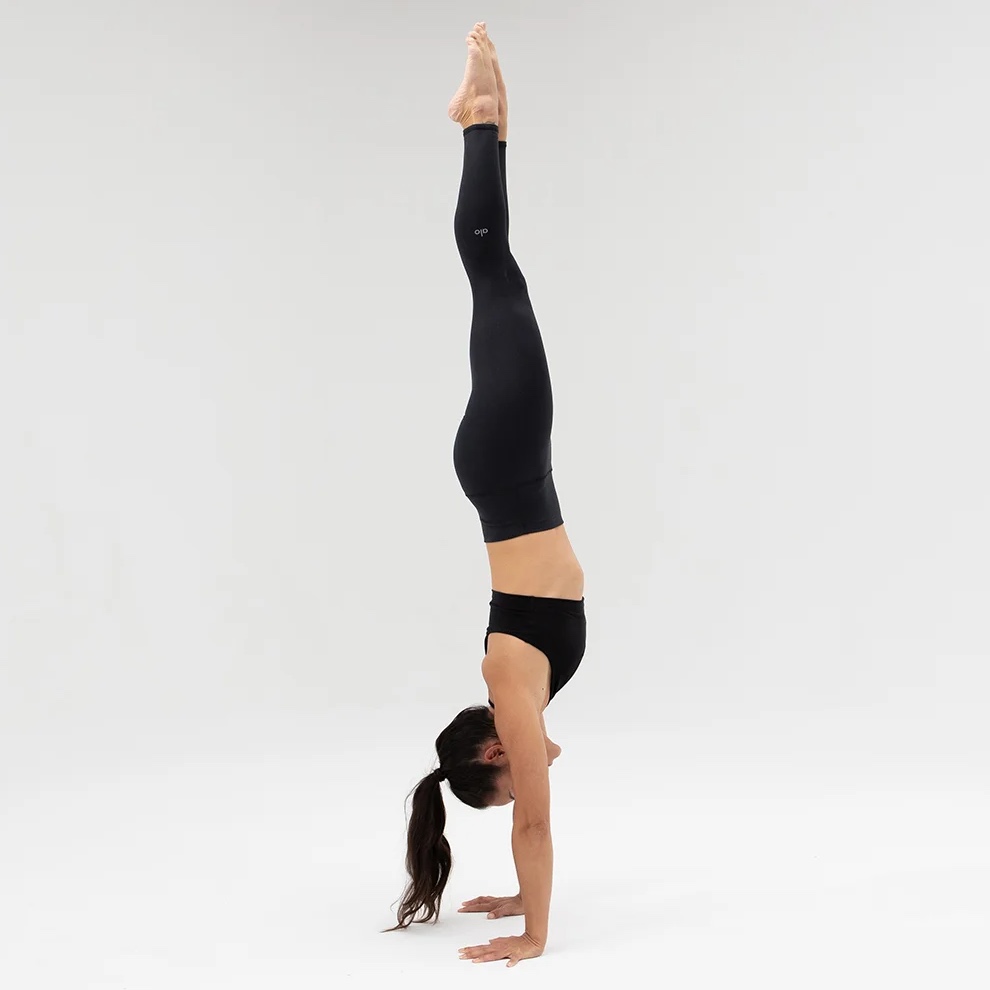
Handstand
(Adho Mukha Vrksasana)
- ✅ Shoulder complex is safely surrounded by an extremely robust network of large powerful muscle groups.
- ✅ Massive muscles like the deltoids pectoralis major and latissimus dorsi safely manage weight distribution.
- ✅ Trapezius and rotator cuff structures work dynamically together to create a highly adaptable support system.
- ✅ Possesses an incredible physiological capacity for muscular hypertrophy and massive strength gains.
- ✅ Allows you to actively train these large prime movers to safely handle intense weight bearing demands.
Other Safe Inversion Alternatives
Downward Facing Dog (Adho Mukha Svanasana)
Provides many circulatory and stretching benefits of mild inversion without cervical loading. Your head remains completely free and weight is distributed safely through your hands and feet.
Legs Up The Wall (Viparita Karani)
A gentle restorative inversion that promotes venous return and full physiological relaxation without any spinal compression. Ideal for recovery and long term stress management.
Supported Shoulderstand (With Props / Bench)
Distributes weight through the shoulders rather than the neck when utilising blankets or blocks. A yoga inversion bench can allow the head to hang completely free offloading the cervical spine entirely.
Supported Bridge Pose (Setu Bandha Sarvangasana)
When supported by a block beneath the sacrum, this mild inversion triggers the baroreceptor reflex to soothe the nervous system. The cervical spine stays flat on the floor with zero axial compression.
Our Approach: Evidence Based Assessment and Recovery
What to Expect During Your Assessment
Comprehensive Movement Screening
We evaluate your cervical spine mobility shoulder girdle stability thoracic extension and upper extremity strength to identify specific limitations.
Neurological Testing
If you are experiencing radiating symptoms we perform dermatomal and myotomal testing to determine which nerve roots may be affected.
Postural Analysis
We assess your typical posture and movement patterns to identify contributing factors like forward head posture scapular dysfunction or core weakness.
Load Tolerance Testing
We determine your current biological capacity for overhead loading and weight bearing through the upper extremities.
Your Personalised Recovery Plan
Phase 1: Symptom Management
- • Activity modification involving temporary cessation of headstands and provocative positions
- • Targeted active therapy to reduce protective muscle guarding and joint inflammation
- • Gentle cervical mobility exercises to restore standard range of motion safely
Phase 2: Foundation Building
- • Scapular stability exercises to develop proper shoulder girdle motor control
- • Thoracic mobility work to significantly reduce compensatory cervical tracking stress
- • Progressive core strengthening geared specifically for long term spinal protection
Phase 3: Strength Development
- • Overhead pressing progressions to build massive structural shoulder strength
- • Plank and hollow body holds to develop necessary physical inversion prerequisites
- • Controlled elbow stand or handstand progressions if completely appropriate for your goals
Phase 4: Return to Practice
- • Graduated return to your regular yoga practice utilising safer inversion alternatives
- • Long term movement parameters and habit tracking strategies to prevent future recurrence
- • Ongoing metric monitoring and progressive alignment adjustments as needed
If You Cannot Hold an Elbow Stand Yet
The solution is never to dump your body mass onto the floor using your head as a crutch. Instead we address the underlying shoulder stability thoracic mobility or core weakness that is holding you back.
By regressing the movement and progressively loading the major muscle groups that are actually designed to handle mechanical stress you can earn the right to invert safely. This approach builds genuine physical capacity rather than bypassing your limitations through compensation.
Why Choose Square One Active Recovery
for Headstand Related Neck Pain
At Square One Active Recovery we take a fundamentally different approach to treating neck pain. Unlike practices that focus solely on symptom relief we identify and address the underlying biomechanical dysfunction that caused your injury in the first place.
Our Evidence Based Chiropractic Philosophy
We are not your typical chiropractic clinic
While many chiropractors focus primarily on spinal adjustments our approach integrates modern sports science rehabilitation principles and functional movement training. We believe that lasting recovery requires more than just temporary pain relief because it demands building genuine physical capacity.
What Makes Us Different
1. Root Cause Analysis Not Just Symptom Management
When you come to us with headstand related neck pain we do not simply adjust your spine and send you home. We investigate why your neck was vulnerable to injury in the first place by asking critical questions
- • Do you have inadequate scapular stability that forces your neck to compensate
- • Is your thoracic spine too stiff creating excessive stress at the cervical level
- • Are you attempting advanced inversions without the foundational strength prerequisites
- • Does your daily posture from desk work or phone use pre load your cervical spine with chronic stress
We address these underlying issues so you do not just recover but instead become more resilient than before the injury.
2. Active Recovery Over Passive Dependency
Many treatment approaches create patient dependency meaning you feel better immediately after the appointment but symptoms return within days because nothing has fundamentally changed. We take the opposite approach.
We do not cultivate a passive environment. Instead we emphasise active rehabilitation involving strengthening exercises movement retraining and progressive loading strategies that give you ownership of your recovery. Our goal is to make you independent of us rather than dependent on ongoing structural adjustments.
3. Individualised Programming Based on Your Goals
Not everyone needs to perform inversions. Some of our patients simply want their neck pain to resolve so they can return to yoga without restrictions. Others want to progress toward safer inversion variations like elbow stands or handstands.
We tailor your recovery plan to your specific goals through targeted pathways
- • If you want to return to yoga pain free We focus on resolving your current symptoms addressing postural dysfunction and teaching you which poses to modify or avoid cleanly.
- • If you want to build toward safer inversions We create a progressive strength programme that develops the shoulder girdle stability thoracic mobility and core control needed for elbow stands or handstands which are inversions that protect your cervical spine.
- • If you are a yoga teacher or serious practitioner We work with you to understand the biomechanics deeply so you can make informed decisions about your practice and potentially guide your students more safely.
4. Education as Empowerment
We do not gatekeep information. During your assessment and treatment sessions we explain exactly what is happening in your body why certain movements or positions create symptoms and how your recovery plan addresses the root problem.
Understanding the biomechanics of your injury empowers you to perform key actions
- • Make informed choices regarding your long term yoga practice
- • Recognise early warning signs before minor issues become major problems
- • Self manage minor flare ups using the specific strategies we teach you
- • Advocate confidently for your own long term spinal health
5. Integration with Your Lifestyle
We understand that our patients in Singapore lead busy lives. Office workers parents business owners and busy professionals do not have unlimited time for lengthy rehabilitation programmes.
Our approach is engineered to integrate seamlessly into your existing routine
- • Efficient focused treatment sessions that typically last 30 to 45 minutes
- • Home exercise programmes that require minimal equipment and can be completed in 10 to 15 minutes
- • Practical movement modifications you can implement immediately at work in yoga class or during daily activities
We offer flexible scheduling options at our Hong Lim Complex location in Chinatown which remains highly convenient for central business district professionals.
Our Commitment to You
When you choose Square One Active Recovery for your headstand related neck pain you are explicitly choosing a higher tier of professional care
We measure our success not by how many adjustments we deliver but by how quickly we can make ourselves unnecessary to your recovery.
When to Seek Professional Assessment
⚠️ Seek assessment within 48 hours if you experience
- • Neck pain or stiffness that does not improve with rest after 48 hours
- • Any radiating pain into your arms, hands, or face
- • Numbness, tingling, or pins and needles sensations in your upper extremities
- • Measurable weakness in grip strength or arm function
- • Loss of coordination or fine motor control
🚨 RED FLAGS – GO A&E IMMEDIATELY
- • Sudden, severe headache like never before after headstand (possible vertebral dissection)
- • Progressive worsening neurological deficits (e.g., dropping objects, clumsiness in hands)
- • Loss of bowel or bladder control seek emergency care immediately
Early intervention is the most effective way to prevent a temporary strain from becoming a chronic, irreversible issue. The cervical spine is too important and too vulnerable to ignore warning signs.
FREQUENTLY ASKED QUESTIONS
I have been doing headstands for years without problems. Should I stop?
If you have exceptional cervical conditioning, proper technique with active shoulder engagement, and no symptoms, you may be among the minority who can tolerate this stress. However, cumulative loading effects can take months to manifest. We recommend periodic assessment of your cervical spine health and considering whether safer alternatives like elbow stands or handstands could provide the same benefits without the long term risk.
My yoga teacher says headstands are safe if you use your shoulders properly. Is this true?
Proper technique does reduce but does not eliminate cervical loading. Even with optimal shoulder engagement, significant axial force remains on the neck. The question is not whether headstands can be performed with some degree of safety, but whether they are the best choice when safer and more effective alternatives exist.
How long does recovery take if I have already developed symptoms?
This depends on the severity of tissue damage and how long symptoms have been present. Minor facet joint irritation may resolve in 2 to 4 weeks with proper management. Nerve root compression or disc related issues may require 4 to 6 months, or even longer. Early intervention significantly improves outcomes.
Can I continue yoga while recovering?
Absolutely. We will help you modify your practice to avoid provocative positions while maintaining your fitness and flexibility. Most yoga poses are perfectly safe. It is specifically the headstand and similar cervical loaded inversions that need to be temporarily avoided or replaced with alternatives.
Will I need imaging like an X-ray or MRI?
Most headstand related neck injuries can be assessed and managed without imaging. We may recommend imaging if you have severe or progressive neurological symptoms, if symptoms do not improve at all with conservative care within 4 to 6 weeks, or if we suspect significant disc or nerve root pathology.
Are there any benefits to headstands that I cannot get from safer alternatives?
No. The proposed benefits of headstands including improved circulation, core strength, body awareness, and mental focus can all be achieved through safer inversions and exercises that do not compromise your cervical spine. Downward Dog, elbow stands, handstands, and even simple mobility work can provide these benefits without the biomechanical risk.
Take the Next Step
You do not need to compromise your cervical spine to build upper body strength or experience the benefits of inversion. At Square One Active Recovery, we help you develop true physical resilience through evidence based assessment and progressive, individualised programming.
If you have been experiencing persistent neck pain, stiffness, or neurological symptoms after your yoga practice, we can identify the root cause and create a personalised recovery plan that protects your long term joint health.
Ready to address your neck pain?
Square One Active Recovery
538 Upper Cross Street, Chinatown
Singapore 050538