
You have finished your treatment. The worst of the pain has settled. You are doing your exercises consistently. So why does your knee still feel a little “off” months down the line?
There is a reasonable chance you are not doing anything wrong. You may simply be moving faster than your own biology can keep up with.
A landmark study published in the American Journal of Clinical Nutrition in May 2026 has given clinicians and patients the clearest picture yet of how quickly each tissue inside the knee actually rebuilds itself. The findings should reshape how every patient, chiropractor, physiotherapist, and GP in Singapore thinks about recovery timelines, return-to-sport decisions, and the role of nutritional supplements after injury.
How Long Does It Actually Take for Knee Tissue to Heal?
This study involved patients undergoing knee replacement surgery. Because the operation gave researchers a legitimate reason to go inside the knee, they could take actual tissue samples and measure how fast each part was healing. Without that surgical access, this kind of data would be almost impossible to collect in living humans.
To track the healing process, participants drank small amounts of heavy water. Think of it like a harmless dye that gets absorbed into any newly made tissue, so researchers could see exactly how much rebuilding was happening day by day. They looked at eight different tissues in total, covering everything from muscle and tendon through to cartilage, bone, and the various softer structures inside the knee.
Half the group were also given an extra 40 grams of whey protein to drink daily. This let the researchers answer a second question: does eating more protein actually make your tissues heal faster? That answer turned out to be the most surprising.
Tissue Rebuilding Rates: A Breakdown
Here is what the data from Houtvast et al. showed in terms of daily protein synthesis rates, expressed as the percentage of each tissue being actively rebuilt per day.
| Tissue | Daily Rebuilding Rate |
|---|---|
| Muscle | 1.17% |
| Synovium | 0.79% |
| Fat Pad | 0.53% |
| Ligaments | 0.45% |
| Tendon | 0.20% |
| Cartilage | 0.19% |
| Bone | 0.12–0.21% |
Muscle is rebuilding itself six to ten times faster than tendon, cartilage, or bone. If you damaged cartilage, your muscle tissue has essentially cycled through a full round of repair while the cartilage is still working through its first quarter.
This is not just an academic curiosity. It has direct implications for how we structure our chiropractic rehabilitation and how we talk to patients about their recovery week to week.
What These Numbers Mean for Your Recovery
Let us translate those percentages into something more tangible. Muscle turns over its entire protein content in roughly 85 days. Now consider tendon or cartilage, which take closer to 500 days—well over a year.

This is why we tell patients at Square One Active Recovery that a tendon injury, a meniscus problem, or cartilage damage is not a six-week injury. It never has been. Feeling less pain and achieving full tissue repair are two very different things.
Why Supplements Did Not Speed Up Repair
Perhaps the most counterintuitive finding from this study was what did not work.
Adding 40 grams of whey protein per day for two weeks, a substantial and evidence-informed dose, produced no measurable increase in protein synthesis rates in any of the eight tissues measured. Not in muscle. Not in tendon. Not in cartilage. Not in bone.
The effect was zero across the board.

This matters because protein supplementation is frequently recommended to patients following injury or joint surgery in Singapore and elsewhere. Many patients arrive having been advised to “load up on protein” or having started on expensive whey protein powders in the expectation that this will speed up healing. Based on this randomised controlled trial, a short-term protein boost of this kind is unlikely to do what patients hope at the tissue level.
To be clear, this is not an argument against adequate protein intake. Protein is essential for every aspect of tissue health and repair. What the study suggests, rather, is that a sustained and adequate habitual protein intake matters far more than a short-term supplementation surge, and that tissue rebuilding rates are governed primarily by more fundamental biological constraints. Principally, time and mechanical loading, rather than a two-week nutritional intervention.
For context on general protein targets, research consistently supports around 1.6 to 2.0 grams per kilogram of body weight per day for physically active adults. Achieving and maintaining that baseline is where the genuine nutritional benefit lies.
Why Connective Tissue Heals So Much More Slowly Than Muscle
To understand the dramatic gap in rebuilding rates between muscle and connective tissue, it helps to understand what these tissues are actually made of and how they are structured.
Skeletal muscle is metabolically active. It is richly supplied with blood vessels, densely packed with mitochondria, and its primary structural proteins, actin and myosin, are in a constant cycle of breakdown and synthesis as part of normal muscular function. The same biological machinery that allows muscle to adapt rapidly to training also allows it to repair itself relatively quickly after injury.
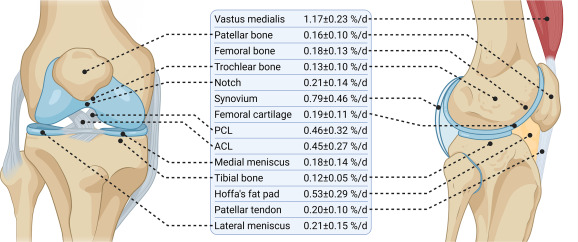
Anatomical depiction of musculoskeletal tissues of the knee joint and their corresponding daily protein synthesis rates (fractional synthesis rates, expressed in %/d).
Connective tissues, including tendons, ligaments, cartilage, and bone, are an entirely different matter. They are composed predominantly of collagen, a structural protein that is exceptionally slow-turnover by its very nature. Tendons and ligaments are also notoriously hypovascular, meaning they receive only a limited blood supply. This restricts the delivery of oxygen, nutrients, and the repair cells that tissue healing depends on.
Cartilage represents the most extreme case. Adult articular cartilage, the smooth tissue that lines the surfaces of joints, has essentially no blood supply at all in the adult body. It relies on diffusion from synovial fluid for its nutrition. This is precisely why cartilage damage is so clinically significant and why the body’s capacity for spontaneous cartilage repair is so limited once you move past childhood.
This study gives us sharper scientific language for a conversation we are already having. When someone presents with a knee ligament sprain or tear, we can now point to specific data showing that ligament tissue, rebuilding at approximately 0.45% per day, requires months of sustained, progressive loading to achieve meaningful structural recovery. The goal of early treatment is not only pain relief but creating the right mechanical environment for the collagen remodelling process to proceed optimally over that extended timeline.
Mechanical Loading: The Driver of Repair
If short-term protein supplementation does not meaningfully accelerate tissue repair, what does?
The most robust evidence in musculoskeletal medicine consistently points to progressive mechanical loading as the primary driver of connective tissue adaptation and structural recovery. This principle, broadly referred to as mechanotherapy, underpins evidence-based rehabilitation across physiotherapy, sports medicine, and chiropractic.
Tendons, ligaments, and cartilage are all mechanosensitive tissues. When appropriately loaded, they upregulate collagen synthesis, reorganise fibres along lines of mechanical force, and gradually increase in tensile strength and stiffness. When unloaded through prolonged rest or immobilisation, they atrophy. Their synthesis rates fall, their structural integrity degrades, and the risk of injury upon return to load actually increases.
This is precisely why complete rest, beyond the initial acute inflammatory phase, is rarely the right answer for a soft tissue injury. The tissue needs to experience progressive mechanical stress to rebuild optimally. The challenge is calibrating that load correctly across a timeline that matches the biology of the specific tissues involved.
A 2019 study by Smeets et al. from the same research group at Maastricht University established comparable baseline protein synthesis rates for these same knee tissues using a different tracer method, and their findings were consistent with the new 2026 data. The convergence across two independent studies using different methodologies gives the rate hierarchy presented in the Houtvast et al. paper considerably more weight.
At Square One, structuring load progression in a way that respects these biological timelines is central to how we design rehabilitation programmes. Whether you are recovering from a knee injury, returning to running after a period of pain, or building back up following surgery, the programme needs to be built around the tissue, not just around your symptoms.
A Note on Post-Surgical Recovery
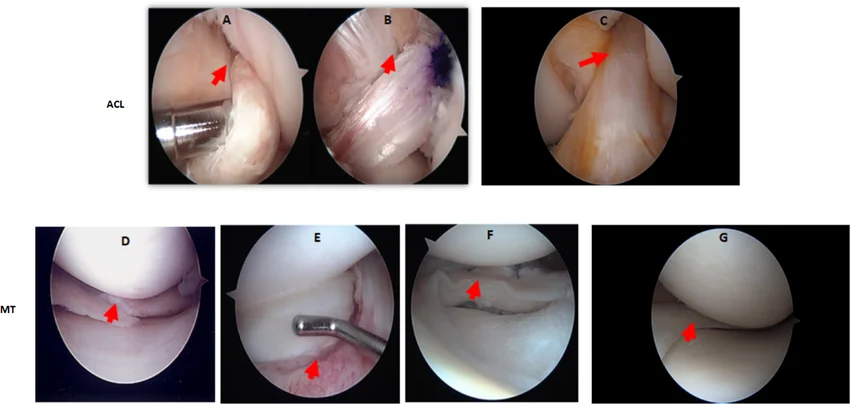
It is worth addressing the post-surgical population specifically, given that the Houtvast study recruited participants undergoing total knee replacement. Many of our patients in Singapore are recovering from procedures including total knee arthroplasty, ACL reconstruction, and meniscal repair.
The biological timelines revealed in this study apply with particular force to the post-surgical context. Surgery creates tissue injury, and while it addresses the structural problem that made surgery necessary in the first place, the surrounding tissues, tendons, ligaments, capsule, and muscle, all need to go through the same slow process of remodelling.
At Square One, we help you manage these expectations and build structured, progressive programmes that account for these biological timelines. Post-surgical patients are also particularly vulnerable to the expectation mismatch described earlier. Pain often improves substantially in the first few weeks as the acute inflammatory response resolves. This can create the impression that recovery is nearly complete. The Houtvast data makes clear that this improvement in pain reflects the resolution of inflammation, not the completion of structural tissue repair.
Supporting Older Adults in Singapore
This study was conducted in older adults, which is clinically significant in its own right. Singapore has one of the fastest-ageing populations in Asia, with the proportion of residents aged 65 and above projected to reach around 25% by 2030 according to the Ministry of Health Singapore.
Older adults experience what researchers call anabolic resistance, a relative blunting of the muscle protein synthesis response to nutritional and mechanical stimuli. Even accounting for this, the Houtvast study shows that muscle tissue in older adults still rebuilds significantly faster than connective tissue. The fundamental hierarchy, muscle fastest and cartilage and bone slowest, holds across age groups.
For older patients managing joint injuries, this reinforces the importance of beginning structured rehabilitation early and maintaining it consistently. Prolonged rest in older adults carries significant collateral costs: rapid muscle loss, general deconditioning, and slower functional recovery across every tissue type. The goal is always to find the appropriate balance between adequate rest and progressive loading, guided by the specific tissues involved and their known biological timelines.
If you are an older adult in Singapore working through a joint injury or managing persistent knee pain, our chiropractors at Square One have experience working with this population and building programmes that respect both the pace of healing and the importance of keeping you active. You can learn more about our approach on our chiropractor Singapore page or visit us at Hong Lim Complex, a two-minute walk from Chinatown MRT.
Key Takeaways for Your Recovery
Bringing the Houtvast et al. research into practice, here is how you should approach your rehabilitation:
-
1
Match your expectations to the biology. Muscle heals in months. Tendons, cartilage, and bone take 1–2 years to substantially remodel. Pain reduction is not the same as structural healing; returning to high-load activity too early carries a genuine re-injury risk.
-
2
Progressive loading is the primary driver. Forget short-term fixes; the injured tissue must be progressively and appropriately loaded to drive collagen remodelling and structural recovery.
-
3
Prioritise habitual protein intake. Aim for 1.6–2.0g per kg of body weight daily. A two-week supplement burst is unlikely to change your tissue synthesis rates—long-term consistency is your foundation.
-
4
Consistency wins over intensity. Connective tissue responds to months of sustained, progressive input. A 12-month plan beats a “heroic” 6-week effort every time.
-
5
Work with a specialist. You need guidance from a professional who understands that pain resolution ≠ structural completion and builds programmes based on tissue-specific biological timelines.

