
FULL TEARS HEAL WITHOUT SURGERY
ACL TEAR TREATMENT SINGAPORE
By Jesse Cai (Chiropractor, BSci, BChiro) | Murdoch University
Last updated May 2026
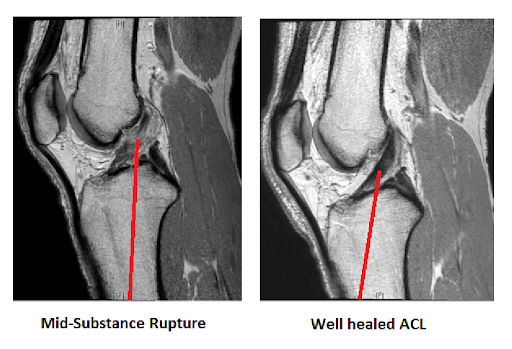
Even if you have torn your anterior cruciate ligament into two, it can still heal without surgery. This may not be intuitive but it shows how robust and adaptive your body is. We specialise in helping you achieve a full recovery for your knee pain through evidence-based rehabilitation rather than invasive reconstruction.
THE CLINICAL EVIDENCE
- KANON Trial: Evidence shows up to 30% of full tears heal on their own without surgery
- Dr Filbay Study: Over half of ruptured ACL cases managed with exercise alone completely healed within two years
Our approach uses clinical strength training to build a muscular brace around your knee to support this natural healing process. With Singapore medical costs rising rapidly, exercise-based recovery is the smartest investment for your long-term joint health.
Rated 5/5 stars 🌟 by 150+ Google reviews.
Recover without the risks of surgery.
CLINICAL PERSPECTIVE
WHAT IS AN ACL TEAR?
An ACL tear is a physical injury to the anterior cruciate ligament which is a primary stabilising tissue in the knee. While many in Singapore believe a full rupture is permanent, modern clinical evidence confirms the ligament possesses a high potential for spontaneous healing without surgery through structured rehabilitation.
-
A Healable Injury: Current research proves that full ACL tears can unite and heal on their own when managed with the correct loading protocols.
- A Stability Challenge: Functional stability depends on the strength of your muscular brace rather than just the structural state of the ligament.
- A Matter of Resilience: Recovery is built by increasing the tolerance of the knee joint through progressive exercise to meet the demands of an active lifestyle.
IS SURGERY BETTER THAN CONSERVATIVE CARE FOR ACL TEARS?
No, high quality peer reviewed research like the KANON Trial shows that conservative care yields long term outcomes equal to surgical reconstruction. Evidence suggests that over 50 percent of full ACL ruptures can undergo spontaneous healing without surgery when managed with a structured rehabilitation programme. Choosing exercise based recovery avoids surgical risks and preserves the natural mechanics of the knee joint.
Conservative care is a safe and effective first line treatment for ACL ruptures. It allows for the possibility of natural healing while building a more resilient knee joint.
Exercise is the most powerful medicine
SQ1 Protocol
CROSS Protocol for Spontaneous ACL Healing
The Cross Bracing Protocol represents a paradigm shift in ACL management based on clinical research from Australia. Historically it was believed that full ACL ruptures lacked the capacity to heal naturally. However recent trials led by Dr Stephanie Filbay have demonstrated that by bracing the knee at 90 degrees for the first four weeks the ligament footprints are brought into close proximity to facilitate spontaneous healing. This evidence based pathway offers an alternative to surgery focusing on biological tissue union followed by intensive functional restoration.
Weeks 0 – 4
Non Weight Bearing
Strict 90 degree flexion to approximate the ACL footprints. We focus on cross education to maintain neural drive in the affected limb.
Weeks 5 – 10
Mobilisation
ROM progressed toward full extension. By week 10 we initiate gait retraining full weight bearing and stationary bike work.
Months 3 – 7
Impact Load
Jogging and skipping begin at week 14. We target 90 percent limb symmetry through sprinting and change of direction drills.
Months 9 – 12
Return to Play
Advanced sport specific retraining. The protocol mandates a minimum 9 month wait to ensure biological healing is complete.
Note: Timelines and progression criteria are based on the Table 1 CROSS Bracing Rehab Protocol.
Clinical Evidence
YOUR JOURNEY TO PERMANENT RESILIENCE
While the CROSS protocol requires initiation within 4 to 7 days, most people only discover this option after that window has passed. That is perfectly okay. In fact, the research supporting high-level ACL recovery through exercise is even more robust, with landmark 20-year studies proving that conservative care is a premier pathway to returning to the sports you love.
Why This Pathway Wins
🎓
Proven Long-Term Success
Athletes followed over two decades showed identical success rates in performance and quality of life compared to those who had surgery.
🦴
Better Joint Longevity
Choosing this robust exercise pathway actually lowers your risk of arthritis according to The American Journal of Sports Medicine. Surgical groups had an 80% rate of knee degeneration compared to exercise groups.
🏋️
Functional Stability
We don’t just aim for a “tight” joint on an exam table. We build a dynamic muscular brace that provides real-world stability for sprinting and pivoting.
Functional Recovery Pathway
Months 0 – 3
Eliminating pain and restoring full range of motion while waking up the quadriceps to support the joint.
Months 3 – 9
Building elite-level strength and capacity. We focus on landing mechanics and explosive power to prepare for sport.
Months 9+
Unrestricted return to performance. We clear you for competition once your strength metrics match your goals.
The Gold Standard Timeline
Why 9 Months is the Critical Milestone for Sport
The Sevenfold Risk of Rushing
Returning to pivoting sports too early is the single greatest predictor of a second injury. High quality evidence from the British Journal of Sports Medicine highlights a staggering statistical reality for young athletes.
Clinical Fact Athletes who return to knee strenuous sport before the 9 month mark have a reinjury rate 7 times higher than those who wait. For every month you delay return up to month 9 the risk of reinjury can reduce up to 84% according to Grindem et al., 2016 and Beischer et al., 2020.
The Three Pillars of Delayed Entry
1. Biological Healing
Whether you choose surgery or exercise the ACL and surrounding tissues need time to mature. Rushing back before this biological process is complete means competing on a joint that is still structurally vulnerable regardless of how strong your muscles feel.
2. Neuromuscular Lag
It takes roughly 9 months for the brain to fully reclaim subconscious control over the knee during fatigue. Most reinjuries happen in the final minutes of a match when the brain fails to stabilise the joint correctly.
3. Symmetry and Power
Achieving 90% strength symmetry is a baseline requirement but true power and plyometric capacity often take the full 9 month window to peak. We ensure you are truly robust before you cross the white line.
ACL Management From Spontaneous Healing to High Performance
EVIDENCE-BASED KNEE RESILIENCE
Clinical Rehabilitation
Whether following the CROSS protocol for tissue union or a conservative pathway we utilise graded loading to eliminate kinesiophobia and restore quadriceps inhibition. This stage bridges the gap between injury and functional movement.
Clinical Pilates
Refining motor control and proprioception through technical movement. This low gravity environment is essential for early stage gait retraining and restoring terminal knee extension without excessive joint shear.
Strength and Conditioning
Your insurance against re-rupture and arthritis. We build a muscular brace with high capacity loading and landing mechanics ensuring the knee is robust enough for the 20 year success shown in clinical trials.
High-Capacity ACL Recovery
Inside the Studio Engineering Knee Stability
Traditional chiropractic clinics often lack the infrastructure for true ACL restoration. Our studio is built for active recovery. Research published in the British Journal of Sports Medicine highlights that long term outcomes for ACL tears depend heavily on restoring 90 to 100 percent limb symmetry in strength and power.
To achieve these results we move beyond generic exercise. We utilise specialised equipment to develop the deceleration capacity and rotational robustness required for a safe return to sport.
| Tool | ACL Focus | Clinical Benefit |
|---|---|---|
| Pilates Reformer | Early ROM and Quad Activation | Low impact eccentric control and closed chain movement to restore knee extension. |
| Squat Racks and Barbells | Absolute Strength | Developing the muscular buffer required to protect the joint under heavy axial loads. |
| Cable Machines | Multi-planar Deceleration | Trains the knee to stabilise against valgus and rotational forces during movement. |
| Plyometric Blocks | Rate of Force Development | Reintroducing impact and landing mechanics for sport-specific readiness. |
Evidence-Based Triage
When is ACL surgery actually needed?
In Singapore, ACL reconstruction is often presented by orthopaedic surgeons as the only way to return to an active lifestyle. Surgery can be useful when conservative management fails, but it should be viewed as a secondary option.
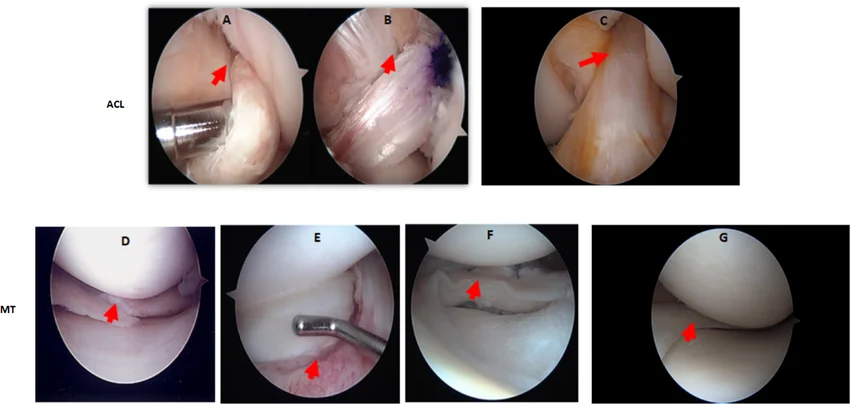
Fig 1. Arthroscopic comparison of (A) Acute Rupture, (B) Post-Surgical Reconstruction, and (C) Healthy Anatomy.
Conclusion: Surgery is a backup plan after other treatments have failed, not a first-line treatment.
Injury Risk Reduction
Building a Bulletproof Knee
ACL tears are often viewed as freak accidents but most are non contact mechanical failures. For athletes and parents in Singapore the strategy must shift from luck to neuromuscular preparation.
When we think of ACL injuries we often imagine the knee being forced into an awkward position by a tackle. While that happens you can actually tear your ACL even without any form of trauma. A 2020 study by Della Villa et al analysed 134 injury videos and found that only 12% were due to direct contact to the knee. Interestingly 44% occurred from indirect contact which is contact elsewhere on the body and another 44% occurred with no contact at all. This proves that injury risk is largely dictated by how your brain controls your movement under pressure.
🧠 Neuromuscular TrainingTeaching the brain to stabilise the knee faster during high stress movements. Training programmes like FIFA 11 plus can reduce injury rates by up to 70% by improving reaction times. Parent Tip Ensure your child’s coach implements evidence based warm ups focused on movement literacy rather than just static stretching. |
👟 Soft Landings and DecelerationTrain to avoid valgus collapse where knees cave inward. Focus on absorbing impact by bending at the hips and knees with quiet feet to reduce peak joint forces. Athlete Tip Practise landing drills in front of a mirror. If your knees knock together when you jump your ACL is at immediate risk. |
💪 The Back Chain DefenceThe hamstrings act as a secondary ACL. Quad dominant athletes are at higher risk. Prioritise Nordic Hamstring Curls to build eccentric strength. Clinical Fact A strong posterior chain pulls the tibia backward which directly mechanically shields the ACL from excessive strain during sudden stops. |
📉 Fatigue ManagementLigaments rupture when tired muscles react too slowly. Overtraining in Singapore’s competitive landscape is a leading cause of neuromuscular failure. Parent Tip Ensure at least 1 or 2 full rest days per week. Avoid early sport specialisation to build more adaptable and robust movement patterns. |
The Square One Takeaway Prevention isn’t about avoiding the sport it’s about building a body that can handle it.
FREQUENTLY ASKED QUESTIONS
How is this different from traditional chiropractic or physiotherapy?
Traditional care often relies on passive treatments like spinal adjustments or massage. The SQ1 Protocol is 100% active. We use specific resistance training and neuromuscular drills to build a biological belt around your joints so you are no longer dependent on a therapist for the rest of your life.
I have a confirmed ACL tear. Is exercise safe without surgery?
Yes. Clinical evidence shows that many individuals can return to high level sport through intensive neuromuscular training without surgery. We identify your current capacity gap and build you up safely so your knee can handle pivoting and daily movement without pain or instability.
Can this help with chronic knee stiffness and clicking?
Yes. Joint sounds are often normal and not a sign of damage. Through progressive loading and desensitisation we improve the structural integrity of the joint and the strength of the surrounding muscles to resolve stiffness and discomfort.
How long until I see results for injury prevention?
Most athletes feel improved control and stability within the first 4 weeks during the initial desensitisation stage. Building true structural robustness and achieving peak performance milestones generally takes between 3 to 6 months of consistent training.
Do I need a doctor's referral?
No referral is necessary. You can book an Initial Movement Analysis directly. We conduct a thorough clinical assessment to confirm your knee health is suitable for our active recovery protocol before starting the programme.
Do I need an MRI or X ray before starting?
Usually not. Research shows that meniscus fraying or minor ligament changes appear on scans of many people even those with no pain. We focus on your functional capacity and how you move rather than treating a picture on a scan. If we spot clinical red flags we will refer you for imaging immediately.
READY TO MOVE BEYOND KNEE PAIN?
Stop the cycle of recurring injury and start building long term resilience
Whether you are dealing with a recent ACL scare or years of chronic instability the SQ1 Protocol provides the strength and autonomy to live a life without limitations.
No referral needed • Evidence based active recovery • Singapore