
I am all about using exercise for pain management. Since 2018, which is the year I started my practice, I decided to go full on exercise-only mode. No chiropractic adjustments, no dry needling, no massage. Essentially, none of those “feel good” therapy.
Exercise wise, I covered pretty much most of the accessible ones in my practice. I teach my clients how to squat, do push ups and pull ups. I have barbells and dumbbells and even a cable machine.
So, why did I decide to bring pilates into my practice?
The ClassPass effect: Exercise is a lifestyle choice today
Whether we like it or not, behaviour changes across time. When I first started my practice in 2018, people didn’t really care as much about how enjoyable an exercise is when it comes to treatment of chronic pain. The general attitude is more of something needs to be done and they are happy to do whatever it takes for that three to four months then bugger off.
It’s a very conscious choice. They have a dedicated time period. They care more about results than palatability of exercise-as-medicine.

Today, attitudes towards exercise has changed. The average Singaporean tend to consider sustainability of an exercise participation in the long-term rather than the results in can yield in the shorter term. It’s not so much about how much pain relief you can give me now but more of how can I keep participating in the said exercise that is going to be helpful.
People already know that exercise is healthy for them. People also know that exercise can help with chronic pain. This is hardly the question that Singaporeans are asking. Chronic pain sufferers want a solution to their problem that also can be fitted into their lifestyle.
Whether I like it or not, pilates is exceedingly popular in Singapore now. It is the most book class on ClassPass for the third year in a row! With this in view, it makes sense to start incorporate pilates into my clinical work. It definitely does help make exercise-as-pain-treatment more appealing.
What is clinical pilates?
Clinical pilates is a specialised form of exercise therapy that closely follow the work of Joseph Hubertus Pilates (1883–1967). It uses pilates principles and adapt it for rehabilitation purpose within an evidence-based context.
I (loosely) follow the Australian Physiotherapy and Pilates Institute (APPI) clinical programme, which is developed by two Australian physiotherapists, Glenn and Elisa Withers. Beyond the traditional pilates method, they introduce clinical reasoning that are more aligned to current rehabilitation understanding than exercise principles from 100 years ago.
There are movements in pilates that are genuinely difficult for people with pain, especially if you were to follow the classical method. Having a clinical version of pilates allow us to modify some of these exercises to not just better suit people in pain but actually help them improve their in their condition.
P. S., APPI is holding their pilates matwork course in Singapore on 4 to 9 July. Super early fee is $2,250 for the six-day course. The course is open to everyone as it is not their clinical pilates programme.
What is the value-add of clinical pilates over other exercises (barbells aren’t always enough)
The first is familiarity and comfort. From a branding and marketing perspective, pilates has done very well to make sure everyone on social would have at least seen a reformer before.
Not only is there familiarity, there is also comfort in that it is safe. We see people of all ages, shapes, and fitness level trying pilates on social media. It sort of reinforces the message that it is suitable for people of all fitness level. When it comes to sedentary chronic pain patients who tend to be more deconditioned, there is an assurance that pilates will not injure them. That assurance and perceived suitability is very important for exercise adherence.
Pilates also use different apparatus to help people move better. My personal favourite is the cadillac and the reformer. For the cadillac, there are countless ways to regress an inversion. That means almost everyone, regardless of fitness level, can attempt some sort of pulling/hanging movement without feeling like they are unfit.
Why are inversions relevant to people in pain
One of the big topics in chronic pain research is fear avoidance behaviour. People who live with chronic pain tend to be excessively afraid of further injuring or re-injuring themselves. This lead them to avoid certain movements, exercises, or activities that end up with more harm than benefit.
Inversions are a great exercise to get people moving freely again. It is indeed a complex movement but yet in the complexity, there is freedom. For a chronic pain sufferer, movements become very “small”. They tend to excessively limit their range of motion cos it feels safer. Movements also become more rigid and guarded.
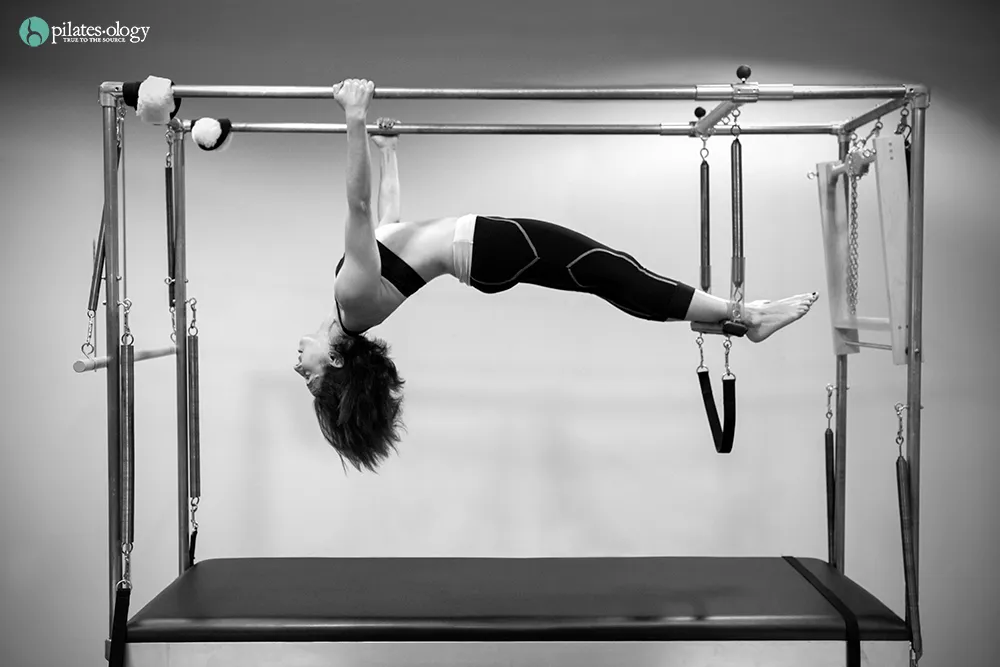
By flipping them upside down, only when they are ready of course, we reset the nervous system. When you are inverted, your usual gravity-based “anchors” are gone. Your brain is a flooded with tons of new stimuli, you experience your body moving in ways that seemed impossible. All of these experiences help “rewire” the brain and really challenge the “fragile” or “broken” identity that a lot of chronic pain patients tend to adopt.
Of course it’s also possible to do inversions on gymnastic rings but the barrier to entry is very high. You need to be able to keep the rings stable with your own strength. Even if I were to hold the rings for you, you still need to know how to kick up into the inverted position and figure out when you are actually inverted. It’s very overwhelming for most people.
Reformer is great for sciatica patients
I genuinely love the reformer for sciatica patients. Sciatica is one of those strange conditions that can make it difficult for people to both sit and stand. When you cannot sit and stand comfortably, the exercises you can do are very limited. This is when palatability comes in again. Nobody really wants to do the same old boring “physio exercises” again and again. It is not enjoyable. And you don’t really want to spend too much time in positions that are uncomfortable cos … well, it’s just not nice.

This is where the reformer makes a difference for sciatica. Reformer allows sciatica patients to do many lower limb exercises in a comfortable recumbent position. Supine, lying down on your back, feels particularly safe and comfortable.
Supine loading without the compressive force of gravity on the painful spinal disc is much better tolerated than exercises done standing or seated. Within this comfortable position, you can train your legs in almost all directions without having to worry about aggravating your spinal disc or sciatica! More comfort equals more exercising!
Neuromuscular control is about precision over power
While squats and deadlifts are the winners for building raw lower limb strength, sometimes people need and want more than just strength? Pilates is indeed quite gentle and the various apparatus can provide support and incremental resistance to get people moving again.

It’s great for building neuromuscular coordination. For sedentary people who are new to exercising, they don’t really know where their limbs are in space. It does take some time before they can start feeling how their bodies are moving. Pilates apparatus allows us to better isolate certain joints and help people gain awareness of how their small joints move. While a barbell requires you to move a heavy object from point A to point B, the pilates apparatus requires you to feel every inch of the journey.
By using the springs and pulleys to provide constant feedback, we can dial into specific movement patterns. We can work on segmental spinal control and pelvic stability, which are often hard to address during larger, compound lifts.
Pilates is not about lifting more It’s about moving better so you can lift more. Think more efficient movements.
Pilates is not here to replace strength training
TL;DR: I’m adding clinical pilates not to replace strength training, but to provide a lower-barrier, high-precision entry point for chronic pain recovery.
I know pilates is the “it” workout on social media right now. But I am not one who is interested in trends. What I’m interested in is what gets you back to an active, healthy lifestyle without pain.
If you’ve been stuck in a cycle of “feel-good” therapies that don’t last, or if you’re too intimidated to touch a barbell because your back is acting up, let’s change that for you.
Book in for an appointment to experience clinical pilates conducted by a no fluff chiropractor. No chiropractic adjustments, no massage. Just evidence-based movements to get you moving pain-free again.
BOOK A CHIROPRACTOR IN SINGAPORE
Based in Singapore, Square One Active Recovery offers treatments with a very big difference. With our evidence-based exercise approach, you can achieve your recovery goals in just 12 weeks. Not getting results from your chiropractor, TCM doctor or physiotherapist? Talk to us and find out how we can take your recovery to the next level.
Our goal? To make our own services redundant to you.
*We do not offer temporary pain relief such as chiropractic adjustments, dry needling, or any form of soft tissue therapy.

