
Just this weekend, a client was complaining that he can’t feel his glutes. He has been doing his home exercises but doesn’t seem to be getting anywhere. He attributed it to that his glutes are not working.
Today, we will explore what is glute amnesia or dead butt syndrome.
The Great Gluteal Amnesia Con
I’m going to ruffle some feathers here, but your glutes haven’t forgotten how to work! They haven’t gone to sleep, and they certainly haven’t developed amnesia.
Think about it logically. If your glutes truly “forgot” how to work, how do you do you think you are standing from your chair or walking up the stairs? Your glutes are 100% working.

Perhaps you don’t feel them working. Perhaps they are not as strong as they used to be. But I promised you, you cannot forget how to use your glutes.
This whole concept has been so thoroughly misunderstood that we’ve created an entire industry around “activating” muscles that were never actually switched off in the first place.
Dr Stuart McGill’s research on glutes and pain
The fitness and therapy world has taken Dr Stuart McGill’s research on pain-related muscle inhibition and twisted it into something it was never meant to be.
McGill’s actual research showed that low back pain could temporarily reduce glute activation. This wasn’t about sitting at your desk or having poor posture. It is about pain. It is how the brain responds to pain by reducing neural drive to muscles around the affected joint.
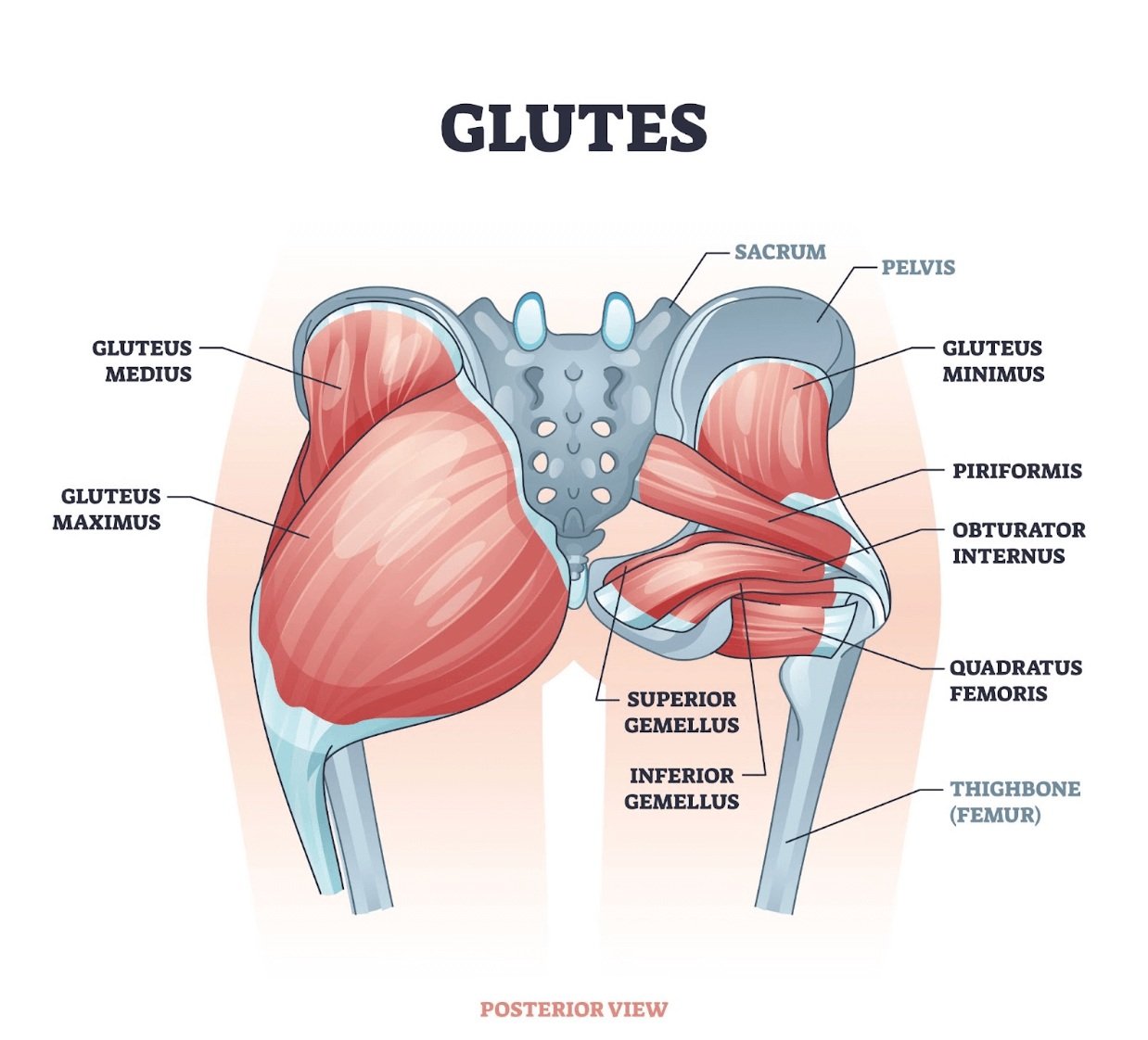
What McGill originally coined as “gluteal amnesia” can likely be better referred to as pain-associated gluteal inactivation. It is not that the glutes “forget” how to fire. Rather, it is the collective changes to our posture, preferred positions, that are contributing to some form of musculoskeletal dysfunction.
But somehow, this specific research finding about pain-induced inhibition got bastardised into the idea that sitting at your desk job makes your muscles forget how to work. Nonsense la!
Your muscles don’t have Alzheimer’s
Your glutes cannot simply turn off. Even if you tried, you can’t consciously choose to not use the glutes. Everytime you stand from the chair, your glutes will be firing, whether you like it or not. And you can’t stop it!
The neuromuscular system doesn’t work like a light switch that you can accidentally flip to the “off” position. Unlike nerve damage or a medical condition that causes true muscular atrophy or paralysis, gluteal “inhibition” is more about weakness than an inability to activate.
Poor awareness of your glute musculature
Sometimes it also has to do with proprioception. Proprioception refers to your body’s ability to sense its position, movement, and spatial orientation without relying on vision. In other words, awareness. Sometimes our glutes are working just fine but we cannot feel it. This was what happened with my client.
He mentioned a couple of times during our session that he couldn’t feel his glutes working. To demonstrate that his glutes are working, I got him to hop on the reformer.
We started with bridges, which got his hamstrings firing. Once we started getting him to keep his pelvis stable and to do the one leg variations, he started to feel his glutes.

The issue in his case is that the sensitivity towards the sensations ar0und his glutes have become poorer overtime. This is likely because of the hip pain that he has been experiencing. However, that doesn’t mean the his glutes are not working or not activating! They are. But he just couldn’t tell.
It’s a perfect example of how the real issue is often much more nuanced than the simplistic “dead butt syndrome” narrative suggests.
Potential contributors to weak glutes
Your glutes are not sleeping. Perhaps they are weaker from disuse. And weakness, unlike mythical muscle amnesia, is actually something we can observe, measure, understand, and fix.
Weakness from disuse
Sitting for long periods doesn’t make your glutes forget how to work. However, prolonged sitting is associated with a sedentary lifestyle. If you are not getting the appropriate exercise you need, they can indeed become weaker over time. This is because you are not providing enough stimulus to help them maintain their strength.
Use it or lose it!
Compensation patterns
Compensation patterns are more complicated. When your glutes are weak, the stress gets redistributed to other areas in the body.
A lot of people think compensatory pattern is about stronger muscles picking up the slack for weaker muscles. However, muscles don’t literally “pick up the slack” as if they’re making conscious decisions to help out their weaker neighbours.
Your muscles are not independent sentient beings that can decide who’s going to do what job.
What actually happens is much more mechanical and predictable. When you need to perform a movement – say, standing up from a chair – your nervous system will recruit whatever muscles are available to complete the task. If your glutes are weak, the force requirements don’t magically disappear. That force demand still exists, and it gets distributed through whatever tissues can handle the load.
The body will use whatever leverage is available to meet the force demands of the task. The “stronger parts” end up handling more stress not through choice, but because they’re the path of least resistance for your nervous system.
It’s a bit like water flowing downhill – it doesn’t choose the easiest route, it just follows the laws of physics. Your movement patterns work the same way.
Poor movement patterns
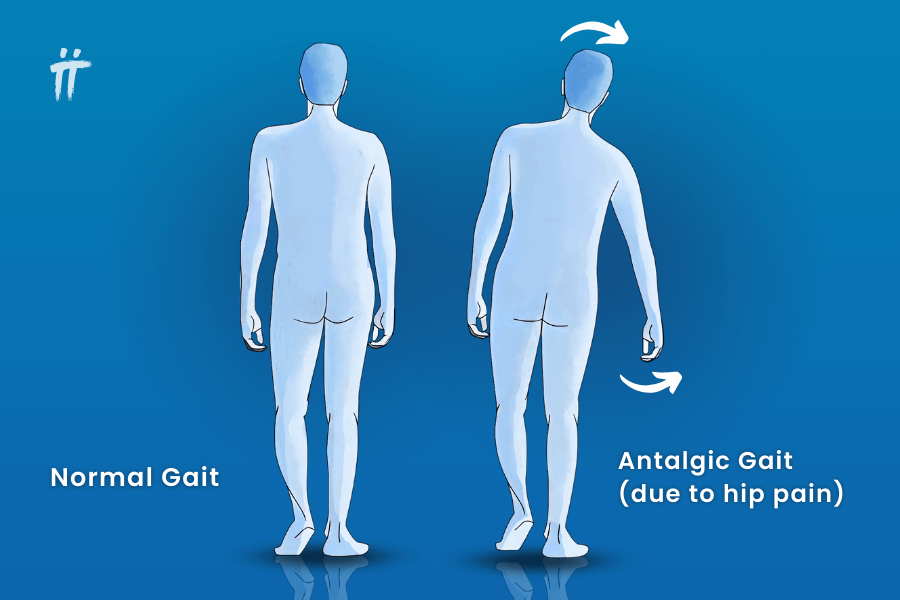
Unlike compensatory pattern, movement patterns are very real and observable. Take the Trendelenburg gait, for example.
The Trendelenburg test is simple. All you have to do is stand on one leg and see if your pelvis stays level. If the pelvis drops on the non-weight-bearing side (i.e., air leg), that’s a positive Trendelenburg sign. This indicate weakness in the gluteus medius on the standing leg.
The Trendelenburg gait occurs during walking. During normal walking, every time you take a step is essentially a single-leg stance on your standing leg while the other leg swings through.

In order to keep your pelvis stable, your gluteus medius needs to fire. When someone has a Trendelenburg gait, you can actually see a pelvis sway. Their pelvis drops with each step, creating that characteristic waddling pattern. It is an observable movement dysfunction that tells us the gluteus medius isn’t doing its job properly.
Five steps to improve your glute health
Step 1: Stop worrying about activation
If you want fast results, don’t obsess over endless activation exercises. Your glutes are already working. What they need is to get stronger, not “switched on.”
Having said that, there is no harm doing some activation exercises to get a feel of your glutes. This can improve proprioception or awareness. However, I wouldn’t fret over it if you can’t feel anything.
What is more important is that you do the right glute exercises, and you do them right.
Exercises like clamshells and glute bridges are good for warm ups. They are glute specific and can help you get a better sensing of your glutes prior to your workout. They can also serve as conditioning exercises for your glutes.
Step 2: Assess, don’t guess
Most of the time people feel like they glutes are not working or that they have weak glutes without actually testing it. At Square One Active Recovery, we don’t guess what’s wrong, we test it.
Trendelenburg test: Can you stand on one leg for 30 seconds without your pelvis dropping?
Single leg glute bridge: Can you perform a controlled single-leg bridge without your pelvis tilting or your back going into over extension?
Movement quality assessment: Are you able to squat and hinge without any aberrant (i.e., extra, unnecessary) movements?
Biomechanical Testing: Is the max force production of the various muscles in the hip area comparable to other people?
Step 3: Build and stability strength progressively
Once we know what’s actually weak, we can actually strengthen it.
If you can barely hold a single-leg stance, we can start there. No point trying to load you with weights if you can’t maintain basic stability.
If stability is a big issue you, you may use the wall for support at the beginning and slowly reduce your reliance on additional aid for stability.
Progress systematically
Adopting a systematic process means you don’t need to rely on how you “feel” for the day. The truth is change doesn’t take place overnight. There is no way your condition can suddenly improve or suddenly regress. Sometimes it can seem that way. But it is only because we do not have the complete picture (i.e., miss the subtle improvements or early signs).
A generic systematic approach may involve starting with double-leg exercises, progress to single-leg supported, then single-leg unsupported, then add external load.
Each step builds on the last.
Step 4: Address movement patterns
Strength alone is not going to be good enough. You need to be able to use the strength in meaningful ways. It’s not about targeting the glutes or isolating the glutes. It’s about integrating the glutes with the rest of the body so you can carry out meaningful activities!
Earlier we talk about stability, stability is important for good movement patterns. If you cannot hold yourself stable, you cannot have good movements. Some areas of stability to look at include:
Are you able to keep your foot firmly planted? It is common for people who spent a lot of time in shoes to poor ankle or mid foot stability. When standing on one leg, the foot will starting rolling about rather than being held firmly in place.
Don’t forget the knee stability issues
Are your knees caving in? If your knees are caving in, there may be some coordination issues with the muscles in your lower limb. For example, the gluteus medius and minimus are hip abductors. They stop the femur bone from moving inwards (i.e., adduction).
The piriformis, gemelli, obturators are your hip external rotators. They stop your femur bone from turning onwards. All these muscles need to work together in a coordinated fashion to ensure your knees stay stable during a squat.
This is where my work as a chiropractor comes in. Through proper coaching, we are able to teach you how to train your body to coordinate movement efficiently. It’s not just about cranking at the gym or lifting heavy weights. It’s also how about how the exercises are being done.
Step 5: Be consistent, not perfect
I get that we live in Singapore. You are busy, you work long hours, and you don’t have unlimited time for exercise. That’s fine. What matters is consistency over perfection.
Having two or three focused sessions per week will get you far better results than sporadic attempts at daily “activation” routines. Pick exercises you can do well, progress them systematically, and stick with the programme.
When it comes to stability and movement pattern work, nobody gets it overnight. Change does take time. You need to give your body time to adapt and grow.
What is most important is that you do the right exercises and in the right way. The results will follow.
What do we do different at Square One Active Recovery?
At Square One Active Recovery, we’ve deliberately chosen not to offer certain treatments. For example, we don’t do chiropractic adjustments. Strange for a chiropractor, I know.
But the research is clear! Manual therapy provides temporary relief at best. Your glutes don’t need to be “adjusted” into working.
We also don’t do dry needling. Dry needling, while very safe, still comes with adverse effects. One of my referrals ended up with excruciating pain after dry needling treatment (not my recommendation), even after two days!
We focus on what actually works: exercise, education, and lifestyle change.
Our recovery programme for chronic pain
Most people want instant results, but real change takes time. You can see improvements in movement quality within the session but often takes a few weeks to truly improve. Genuine strength gains takes longer, approximately 8-12 weeks of consistent work.
The good news? Once you’ve built that strength and those movement patterns, they tend to stick around much better than any temporary “activation” you might achieve.
Any skills or knowledge you learn from us can also be directly applied to your own exercise and training at home. You don’t need to come back to us for unlimited treatments.
BOOK A CHIROPRACTOR IN SINGAPORE
Based in Singapore, Square One Active Recovery offers treatments with a very big difference. With our evidence-based exercise approach, you can achieve your recovery goals in just 12 weeks. Not getting results from your chiropractor, TCM doctor or physiotherapist? Talk to us and find out how we can take your recovery to the next level.
Our goal? To make our own services redundant to you.
*We do not offer temporary pain relief such as chiropractic adjustments, dry needling, or any form of soft tissue therapy.

