
When your knees start to ache, it is natural to focus only on the knee joint. You might feel a sharp pain walking down stairs, a dull ache after a long day on your feet, or stiffness when standing up from a chair. Because you feel the pain there, traditional care often treats only that spot. This usually means passive treatments like quad massages, tight knee braces, joint cracking, or quick fixes that mask symptoms without fixing the root cause.
At Square One Active Recovery, we take a different approach. We look at your whole body as one connected system.
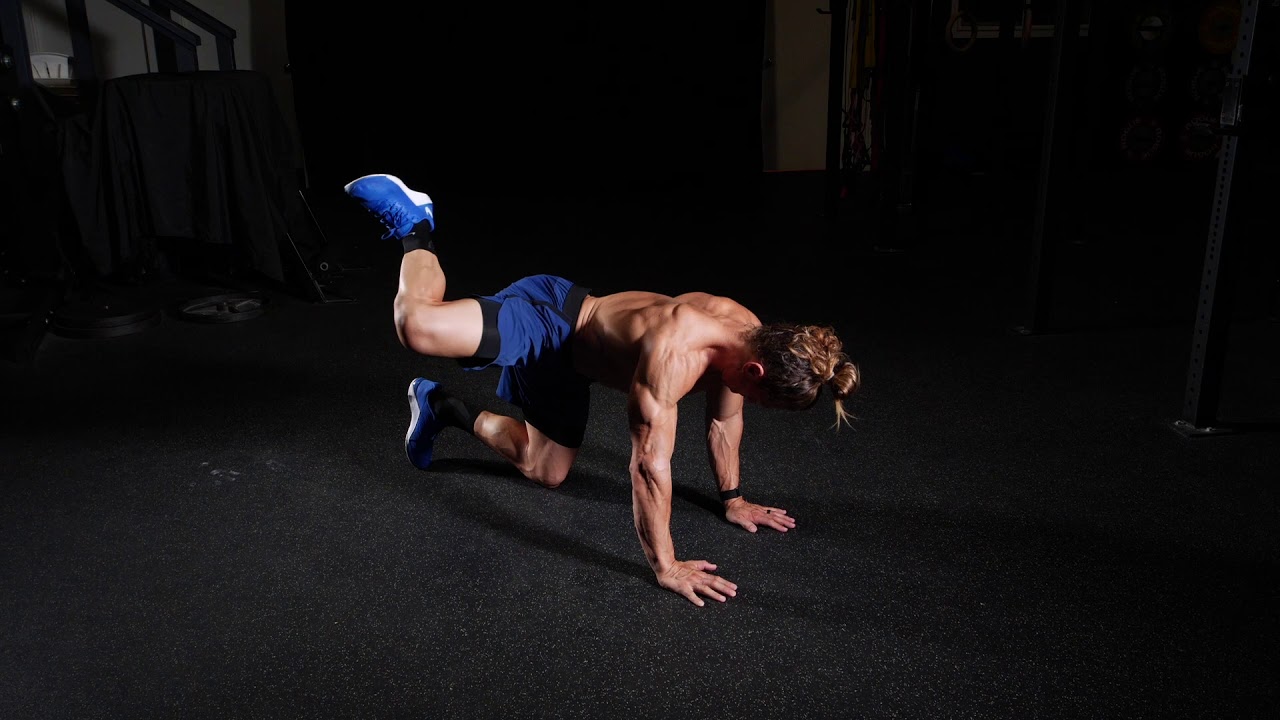
A major scientific review found strong evidence for a missing piece in most knee rehab plans: hip abductor strengthening. Research shows that strengthening your outer hip muscles, like the gluteus medius, is essential for managing knee osteoarthritis (OA) and general knee pain. However, fixing your hips is only the first step. To truly protect your knees for life, we need to look beyond single muscles and train your entire lower body under load.
1. Why Your Hips Control Your Knees
Your knee joint sits right between your ankle and your hip. It acts mostly like a simple hinge that bends and straightens. Because of this, it relies heavily on the stability of the joints above and below it.
Every time you walk, run, squat, or step down, your body must control how your legs move. If your outer hip muscles are weak, your pelvis loses stability. This causes a chain reaction down your leg:
- Inward Knee Collapse: Without strong outer hips, your thigh tends to roll inward when you bear weight. This puts extra sideways stress on your knee joint.
- Uneven Joint Wear: Over thousands of steps each day, this instability puts uneven pressure on your knee cartilage. This speeds up irritation in people with knee OA.
- Better Tracking from Above: Strengthening your hip abductors gives you better control from the top down. Your thigh bone tracks smoothly over your foot, which instantly reduces stress on a sore knee.
Treating knee pain by looking only at the knee is like trying to fix poor wheel alignment by only looking at the tyre tread.
2. Why Hip Exercises Alone Are Not Enough
Learning that your hips affect your knees is a great breakthrough. However, it often leads to a new mistake: focusing only on hip exercises.
When new studies highlight one muscle group, many therapists overreact. They swap knee exercises for endless side-lying clamshells and resistance band walks. They assume that strengthening a singular hip muscle will completely fix the knee.
This narrow view ignores how the human body ages. As we get older, we naturally lose overall muscle mass, strength, and power. Doctors call this sarcopenia and dynapenia. This muscle loss does not happen in just one spot. You do not only lose strength in your outer hips while your thighs, hamstrings, and calves stay completely strong. Muscle loss affects your entire lower body.
If your rehab stops at small, single-joint exercises, you are only training isolated parts. Your body needs to work as one strong, connected unit. A knee cannot heal or stay healthy on its own.
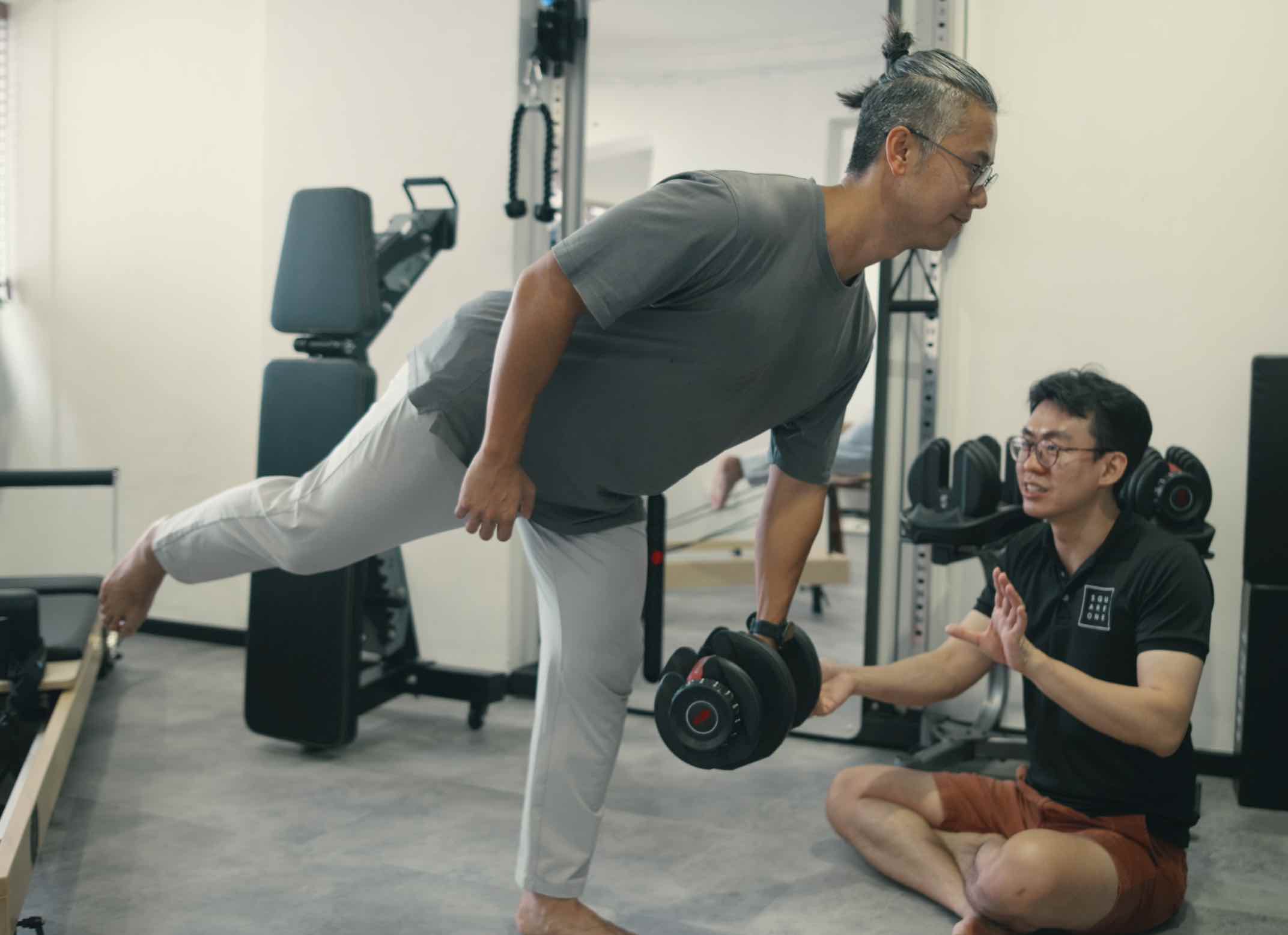
3. A Whole-Body Approach: The Power of Compound Lifts
To fight age-related muscle loss, ease chronic joint pain, and stay active in daily life, you need a global approach to fitness. This means doing multi-joint compound exercises that train your entire lower body at the same time.
Compound movements like squats and deadlifts are the best way to build lasting strength. They teach your ankles, knees, hips, and back to work together to handle heavy loads.
Squats: Building Lower-Body Strength
A good squat is not just a leg workout. It is a basic human movement. It teaches your body how to share weight evenly between your hips and knees. When you slowly add weight to your squats over time, you strengthen your muscles, tendons, ligaments, and bones around the knee.
More importantly, squatting is an essential functional movement for daily independence. You use this exact movement pattern every time you sit down on a chair, get out of bed, or use a squat toilet. Training your squat in the gym directly protects your ability to handle these everyday tasks with ease.
Deadlifts: Strengthening the Back of Your Body
While squats target the front of your thighs, deadlifts build strength along the posterior chain or back of your body. They train your glutes, hamstrings, and back muscles. Strong hamstrings and glutes act like shock absorbers that protect your knees every time you walk or climb stairs.
| Exercise Category | Primary Targets & Focus | Role in Knee OA Rehabilitation |
|---|---|---|
| Hip Abductor Isolation | Gluteus Medius, Gluteus Minimus, Tensor Fasciae Latae (TFL) | Keeps the pelvis and thigh steady, stops the knee from rolling inward, and lowers joint strain |
| Pilates | Deep Core (Transverse Abdominis), Pelvic Floor, Deep Hip Stabilizers, Body Alignment | Improves movement control, body awareness, and low-load endurance for early rehab |
| Compound Squats & Deadlifts | Quadriceps, Hamstrings, Gluteus Maximus, Back Muscles, Calves | Builds bone density, fights age-related muscle loss, and prepares your legs for heavy daily loads |
4. You Are Never Too Old to Squat or Deadlift
Many people believe that aging makes our bodies fragile. Older adults are often told to stick to light plastic dumbbells or avoid bending their knees deeply.
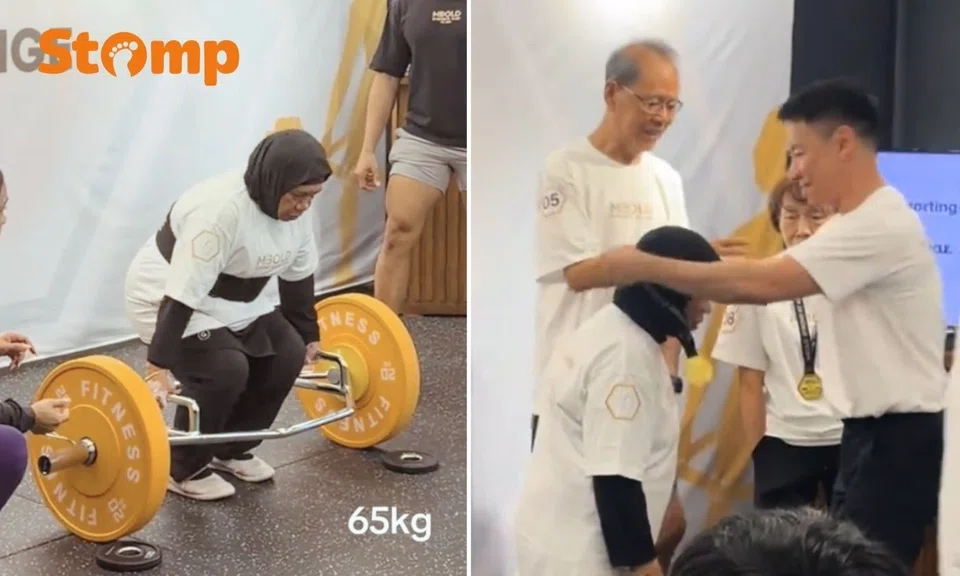
Real stories from right here in Singapore prove that you are never too old to lift heavy weights:
- Madam Lim Lean Ee (The “Granny Powerlifter” at 71): At 71 years old, Madam Lim achieved a personal best sumo deadlift of 70kg. That is more than 110% of her own body weight. She also squatted 45kg and bench pressed 30kg. Getting stronger gave her the stamina to cook huge batches of food for hospice charities without getting exhausted.
- Madam Rosemina Hamzah (Deadlifting 67.5kg at 73): In her early 70s, Rosemina struggled to climb stairs, walk comfortably, and kneel during daily prayers due to knee pain. Instead of relying on a mobility scooter, she started a structured strength program with her daughter. Within a year, she deadlifted 67.5kg in a competition. Her knee pain during prayers disappeared completely, and she now climbs stairs easily and trains for HYROX events.
These two women prove a simple biological fact. Your body does not lose its ability to get stronger just because you turn 60 or 70. The muscles and joints of a 70-year-old adapt to strength training in the exact same way as those of a 20-year-old.
5. The Square One Approach: Building Your Independence
At Square One Active Recovery, we measure success by how independent you become in your daily life, not how often you need to visit our studio.
Passive treatments like routine chiropractic adjustments, massages, or rigid braces can make you feel fragile and rack up chiropractic fees. They send a subtle message to your brain that your body is broken and needs constant outside help.
True recovery requires a new mindset:
- Choose chiropractic rehab over passive fixes so you build real physical strength rather than just hiding pain.
- Replace fear with confidence by learning to trust your body under load.
- Combine targeted exercises with big movements by pairing outer hip work with squats and deadlifts for total lower-body strength.
You do not have to let knee pain control what you can and cannot do. By strengthening your hips and embracing full-body strength training, you can build resilient knees that last.
Key Takeaways
Keep these three principles in mind when managing knee pain and knee osteoarthritis:
-
1
Look Above the Knee: Strong research shows that strengthening your outer hip muscles helps reduce knee OA pain by improving how your leg moves.
-
2
Do Not Stop at Small Exercises: Isolated hip drills are a great start, but you need compound lifts like squats and deadlifts to build whole-body strength and prevent muscle loss.
-
3
Age Is Not a Barrier: Stories like Madam Lim (70kg deadlift at 71) and Madam Rosemina (67.5kg deadlift at 73) show that your body can adapt and grow stronger at any age.

