
When embarking on a journey toward long term, sustainable physical recovery, it is completely natural to wonder: How do we actually know it is working? If pain relief isn’t the sole benchmark we used at Square One Active Recovery for success, what yardsticks do we use to track progress?
Here is a breakdown of how data-driven clinicians measure real, lasting progress, moving from objective physical testing to understanding the fascinating psychology of pain itself.
1. Objective Assessments: Data Over Guesswork
Objective testing removes the guesswork from recovery, giving clinicians and patients concrete data points to compare pre- and post-intervention.
- Dynamometer Strength Testing: This Biomechanical Assessment is a gold standard for measuring raw force output. By using a handheld or fixed dynamometer during pre- and post-tests, we can track exact changes in muscle force production rather than relying on a vague feeling of feeling stronger.
- Capacity-Based Testing: Objective testing also evaluates endurance and work capacity. This can look like measuring how many seconds you can hold a plank, how many push-ups you can execute with proper form, or how many bodyweight squats you can complete in a minute.
- Return-to-Sport Benchmarks: In specific rehabilitation contexts, such as recovering from a knee injury, clinicians rely on validated functional tests. For example, the one-leg sit-to-stand test is frequently utilised. It is a validated clinical metric where practitioners look for specific performance targets, such as performing 22 reps or 15 reps in 30 seconds, to ensure the limb is truly ready for high-demand activity.
- Condition-Specific Clinical Tests: In conditions like ankylosing spondylitis, specialized tests track structural limitations. The Schober’s test, for instance, measures lumbar spinal mobility and flexibility. A normal result typically shows an increase in total distance of at least 5 cm (e.g. expanding from a baseline mark of 15 cm to 20 cm or more during forward flexion), indicating healthy lumbar spine flexibility.

2. Quasi-Objective Testing: The Balance of Measurement and Observation
Some clinical assessments may sit in a grey area between pure quantitative data and qualitative observation.
- Range of Motion (ROM) & Scoliosis Screening: Range of motion is a staple of clinical examinations. Take the Adams forward bend test, often used for preliminary scoliosis screening. Clinicians usually eyeball the symmetry of the back. However, while visual estimation is common, it is entirely possible to take rigorous, objective measurements by introducing a Scoliometer to quantify trunk rotation.
- The Goniometer Reality: Similarly, joint range of motion can be meticulously measured using a goniometer (a specialised protractor for joints). However, most clinicians default to eyeballing range of motion relative to anatomical landmarks to save time.
3. Why Pain Perception Alone Is a Flawed Benchmark
Pain is never a reliable standalone indicator of recovery. Indeed we often ask clients about their pain scores because that is the primary motivator for most people to seek treatment. While pain is not a outcome measure to track recovery, we still want to achieve pain resolution at the end of the recovery period.
The first concept to appreciate is that pain is more perception than it is a sensation. It is profoundly multi-factorial and easily influenced by changes in our external environment and internal state.
Human perception is remarkably malleable and easily tricked by contextual cues, as demonstrated by robust psychological and psychophysical studies:
- The Hue-Heat Hypothesis & Visual Context: Research exploring the hue-heat hypothesis shows that visual and environmental colors drastically bias thermal and sensory perception. For instance, studies examining interior design and environmental psychology demonstrate that exposure to warm-toned colors like red or yellow can elevate a participant’s thermal sensation votes and perceived warmth, whereas cool tones like blue can suppress them, even when the actual ambient temperature remains completely unchanged.
- The Thermal Grill Illusion (Centralised Pain Perception): Another classic experimental model is the thermal grill illusion, where harmless, non-painful warm (38 to 42 degrees Celsius) and cool (18 to 22 degrees Celsius) interlaced bars are applied to the skin simultaneously. Despite the bars being physically safe and incapable of damaging tissue, the brain integrates these conflicting thermal signals into a paradoxical, intense burning pain. This proves that pain can be manufactured entirely in the central nervous system without any peripheral tissue damage.
Pain operates in a remarkably similarly. It is easily skewed by environmental stimuli, workspace stress, fatigue, and emotional mood fluctuations. You can have two individuals with identical tissue healing states experience vastly different levels of pain simply because one slept poorly, had a stressful day at work, or is feeling anxious about their prognosis.
Because pain is phenomenological, meaning it is rooted entirely in subjective conscious experience, relying on it exclusively as a scorecard means your recovery metrics are constantly shifting sands.
4. The Measurable Outcomes That Truly Matter
True, sustainable recovery is built on a holistic foundation of physical capability. When we track your progress moving forward, we evaluate improvements across five distinct, comprehensive pillars:
A. Range of Motion and Mobility
In conditions like ankylosing spondylitis, the primary long-term recovery goal is to keep the spine moving fluidly through its full, functional range. Relying on pain absence alone is deceptive. A lack of pain may simply indicate a temporary reduction in inflammation, but it does not indicate that the spine is actually capable of flexing, extending, and rotating freely. This is why tools like the Schober’s test are routinely used to assess ankylosing spondylitis function.
Without freedom of movement, the stiffness and loss of mobility will eventually increase and lead to pain. Hence, preserving full spinal mobility is more important for longer term outcomes than pain relief alone.
B. Movement Pattern
Even though we have hundreds of individual bones and muscles in our body, they must ultimately operate as a single, cohesive system. It is true that we can isolate and strengthen muscles independently during rehab. Failing to integrate them coherently, however, results in poor movement efficiency, reduced exercise benefits, and may also contribute to risk of injury. A poor movement pattern or faulty technique, even if paired with impeccable raw strength, remains an independent risk factor for injury.
You can be completely pain-free and still move poorly. Poor movement patterns, even among healthy individuals, eventually lead to pain and injury. If you feel like your pain always comes back or is getting worse despite regular exercise, perhaps the problem is in how you are moving.
C. Functional Movement
Functional movement can be thought of as the basic movement blocks required to carry out activities of daily living (ADLs). A well-coordinated squat movement will allow you to better sit and stand from a chair, tie your shoelaces, or even use a squat toilet when you are overseas.
Functional movements serve as a far superior predictor of your true capacity for independent daily living than pain alone. Without functional movements, you will eventually start to deteriorate and lose your capacity for ADLs over time.
D. Strength
Strength is a superior marker of recovery than pain because it directly measures muscle, joint, and bone health. Poor muscle strength lead to conditions like sarcopenia and osteoporosis.
Even if you currently have no pain but are simply too weak to properly support yourself, your body will eventually start to fail and your pain will inevitably return. It is only a matter of when.
Of course you don’t need to train yourself to be the next pull-up grandma! How much strength you should aim to train for is entirely dependent on the lifestyle you want to support. If your body lacks the baseline strength required to meet the demands of your daily life and activities, there is no realistic way your pain can resolve in any meaningful, lasting way.
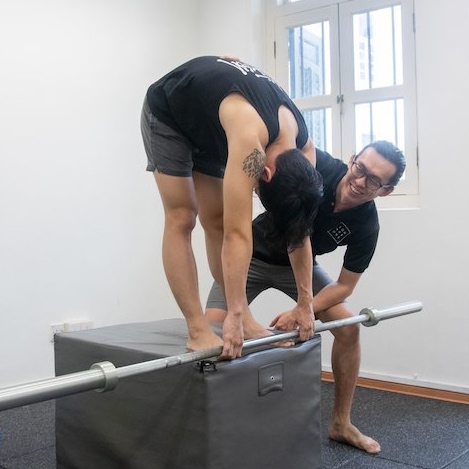
E. Endurance
Endurance means your tissues can sustain force over time without fatiguing prematurely. Consider a ballet dancer: sustained artistic postures, balances, and transitions require profound muscular endurance and core postural control.
If you cannot stand and hold firmly on one leg while your other limbs are moving in space, you do not have enough capacity to to ballet. This is a small but tangible risk of injury. While it is true that you can theoretically build one-leg stability by practising ballet itself, it is extremely inefficient.
We always scaffold physical development from the simplest to most complex. You won’t want to train a toddler to run before they can stand, right? Foundational capacities, like baseline single-leg endurance, should always precede complex artistic or athletic demands. True recovery means building that foundational cellular and muscular endurance first, ensuring your body doesn’t break down when repetition and time under tension stack up.
At a Glance: Core Recovery Benchmarks
| Pillar | Key Focus | Assessment Method | Clinical Goal |
|---|---|---|---|
| Mobility & ROM | Joint freedom & structural range | Schober’s Test, Scoliometer, Goniometer | Preserve full movement regardless of pain twingles |
| Movement Pattern | Coordinated multi-joint mechanics | Visual & functional technique checks | Eliminate hidden compensation risks |
| Functional Movement | Real-world task execution | Squats, hinge mechanics, sit-to-stand | Ensure capacity for daily living |
| Strength | Structural resilience & force output | Dynamometers & progressive loading | Match capacity to lifestyle demands |
| Endurance | Sustained force & postural control | Single-leg balance & time-under-tension | Prevent fatigue-related breakdowns |
5. Do I Need Testing During or at the End of My Recovery Programme?
For most cases, we don’t actively retest strength assessments unless key milestones are not being met. If we can see you literally squatting more weight, we already know you’re stronger. Once symptoms resolve and you have successfully returned to your sports or hobbies, it is not necessary to know the exact numerical increase in your force production.
In instances where recovery is slower than expected or progress stalls, we may opt for regular, targeted testing of specific muscle groups to gain clarity on week-to-week strength changes. This is quite rare in practice. Most clients naturally see and experience their own improvements in daily life. Hence, formal retesting is often seen as unnecessary.
Of course, there is never any harm in retesting, so you can certainly opt for it at any time if you’d like a formal check-in on your progress.
By anchoring your recovery to these tangible, objective metrics, we take the emotional rollercoaster out of healing. Pain may whisper how you feel today, but data shows us how far you’ve truly come.
6. Experience the difference with Square One Active Recovery
Here’s how Square One Active Recovery is different. We don’t just make people exercise and hope for the best. With every client, we meticulously note every detail so we can map out a precise, individualised training plan without leaving your progress to chance.
Our thorough Biomechanical Assessment let us know exactly how hard to push a client at any given stage. Because we have concrete data, we don’t have to guess or be overly cautious out of fear. This prevents your recovery from stalling and missing out on progress. Similarly, we won’t run into the risk of overtraining a client just because they feel great and are super motivated on a particular day.
These objective assessments help keep both the client and myself completely in check. As the saying goes, numbers don’t lie. Our core expertise is in active exercise rehabilitation, movement integration, and helping you build the exact physical capacity your lifestyle demands.
If you’re sick of treatments that seem to lead nowhere and you’re always circling around the same point with no breakthrough, perhaps what you need is a chiropractor-led recovery programme that is more intentional, structured with no trial and error. Book a comprehensive clinical assessment with Square One Active Recovery today.
Key Takeaways
Keep these fundamental concepts in mind when tracking your long term physical recovery:
-
1
Pain is an unreliable progress indicator. Pain is multi-factorial, phenomenological, and symptom levels fluctuate independently of actual tissue healing.
-
2
Measure functional physical capacity. Real progress is tracked across joint mobility, movement patterns, functional movement execution, lifestyle-matched strength and endurance.
-
3
Objective data eliminates guesswork. Biomechanical testing ensures training loads are pushed accurately without overtraining or under-dosing your recovery plan.

