
You spent hundreds or even thousands on a high end ergonomic chair featuring adjustable lumbar support, 4D armrests, and a synchronised tilt mechanism. Yet, by mid afternoon, that familiar dull ache in your lower back returns as per usual.
If this is your daily routine, you are far from alone. Millions of desk workers believe that investing in a premium office chair is their solution for chronic low back pain. While a well designed chair can be an important piece of the puzzle, furniture alone is rarely enough to eliminate spinal discomfort. Ergonomic chairs are still all the rage today, with brands continually releasing high tech models, such as when Interdesk launched their Interglide X5 premium ergonomic chair just a few days ago and ErgoTune was acquired in 2022 for almost 12 million dollars.
However, a proper workstation setup is essential only for managing immediate loads. Sitting itself creates underlying physiological challenges that no piece of office furniture can fix on its own.
1. The Myth of the Perfect Chair and the Ergonomic Illusion
The human body simply was not designed for prolonged static sitting. No matter how advanced your engineering, ergonomic adjustments, or mesh materials are, sitting is sitting.
Yet, a deeper problem lies in the very marketing of these products. The posture ideals perpetuated by most ergonomic companies are largely not evidence based. The office furniture market is an unregulated industry. Much of the research conducted is proprietary, superficial, and definitely not clinical enough for ergonomic chairs to be considered a legitimate medical treatment.
As critics point out, the word ergonomic has essentially become a marketing synonym for adjustable. Many chairs wearing the label merely offer basic levers rather than solving the foundational physiological reality of sedentary strain.
“A wooden church bench, because you will feel so uncomfortable that you will have to get up after half an hour.”
2. What Happens to Your Body During Prolonged Sitting
When you sit at your desk for hours at a time, several distinct biological processes begin to break down regardless of your chair’s price tag:
- Muscular Deactivation: Your glutes and deep core stabilisers effectively “switch off” from disuse. Without these primary postural drivers doing their job, your spinal ligaments, lumbar fascia, and lower back muscles are forced to pick up the slack, taking over the exhausting job of holding you upright all day.
- Sluggish Blood Circulation: When skeletal muscles actively contract during walking or shifting positions, they physically squeeze the deep veins located inside them. This muscular pump propels blood upward against gravity toward the heart. Sustained sitting stalls this mechanism, leading to stagnant blood flow in the lower extremities and tissues.
- Systemic and Localised Inflammation: Prolonged physical inactivity disrupts metabolic regulation, impacting insulin sensitivity, blood sugar, and lipid processing. This metabolic stress signals the body to release inflammatory markers, including circulating cytokines and interleukins like IL-6 and IL-8, which can amplify your overall pain sensitivity.
- Sustained Tissue and Disc Pressure: Hours of continuous mechanical compression on your intervertebral discs, hip flexors, and facet joints irritate local tissues. Over time, this constant loading triggers localised inflammatory pathways and nociceptive pain signaling.
Can Ergonomic Chairs Improve Your Symptoms?
Yes. A better ergonomic setup can definitely reduce symptoms, especially in the early stages or when an acute flare up hits.
Think of it like air travel. Flying business class is undeniably a more comfortable way to travel because extra legroom, adjustable recline angles, and better support make a long journey much easier on your joints. Meanwhile, cramped economy seats with zero recline and tight legroom tend to aggravate your aches and pain almost immediately.

However, over time, your body adapts to the chair. Sitting is still sitting. The initial relief tends to dissipate, and your aches and pains return because furniture cannot alter the deeper physiological mechanisms happening inside your tissues.
3. Actionable Solutions: What to Do Instead
To truly conquer desk related low back pain, you need to change how you move, sit, and train your body to handle the demands of your workday.
Break Up the Static Load
Stand, walk, and stretch every 30 to 45 minutes. If getting away from your desk is not always possible during a busy crunch time, performing seated calf raises, shifting your weight, or altering your position frequently can help stimulate local blood flow and give compressed tissues a brief respite.
Train Your Body for the Demand
You can train yourself to sit more comfortably without pain. Even though our physiology is not built for hours of stillness, you can build your physical capacity.
Beyond core work, focus heavily on strengthening your glutes and posterior chain to support your spine. Progressive strength training, including targeted isometric hold exercises, works exceptionally well to increase the endurance of your stabilising muscles, helping you tolerate longer periods of sitting without breaking down.
Experiment with Active and Uncomfortable Seating
Ironically, ultra-comfortable, high-support ergonomic chairs can backfire because the sheer amount of passive cushioning encourages long periods of completely static sitting.
Using active seating options, such as exercise balls, balance discs, or dynamic stools, forces your body to engage neglected stabilising muscles and maintain micro-movements throughout the day. Because these options lack a rigid backrest, they naturally prompt you to shift your posture and adjust your weight frequently.
Even a basic, unpadded wooden stool can act as an effective “ergonomic” seat. Because it is inherently uncomfortable for long stretches, it naturally forces you to get up, stretch, and move around, preventing the static tissue compression that leads to low back pain in the first place.
4. Build True Physical Resilience with Square One Active Recovery
If you are trapped in the frustrating, endless cycle of desk related back pain, buying another office chair or relying on temporary passive treatments like massages, heat packs, or quick adjustments will not solve the root problem. True relief does not come from external support. It comes from building a body strong enough to handle your life.
At Square One Active Recovery, located in Chinatown, Singapore, we move away from passive fixes and focus on active, long term rehabilitation. We empower you to take control of your spinal health by building real structural capacity, tissue resilience, and movement confidence.
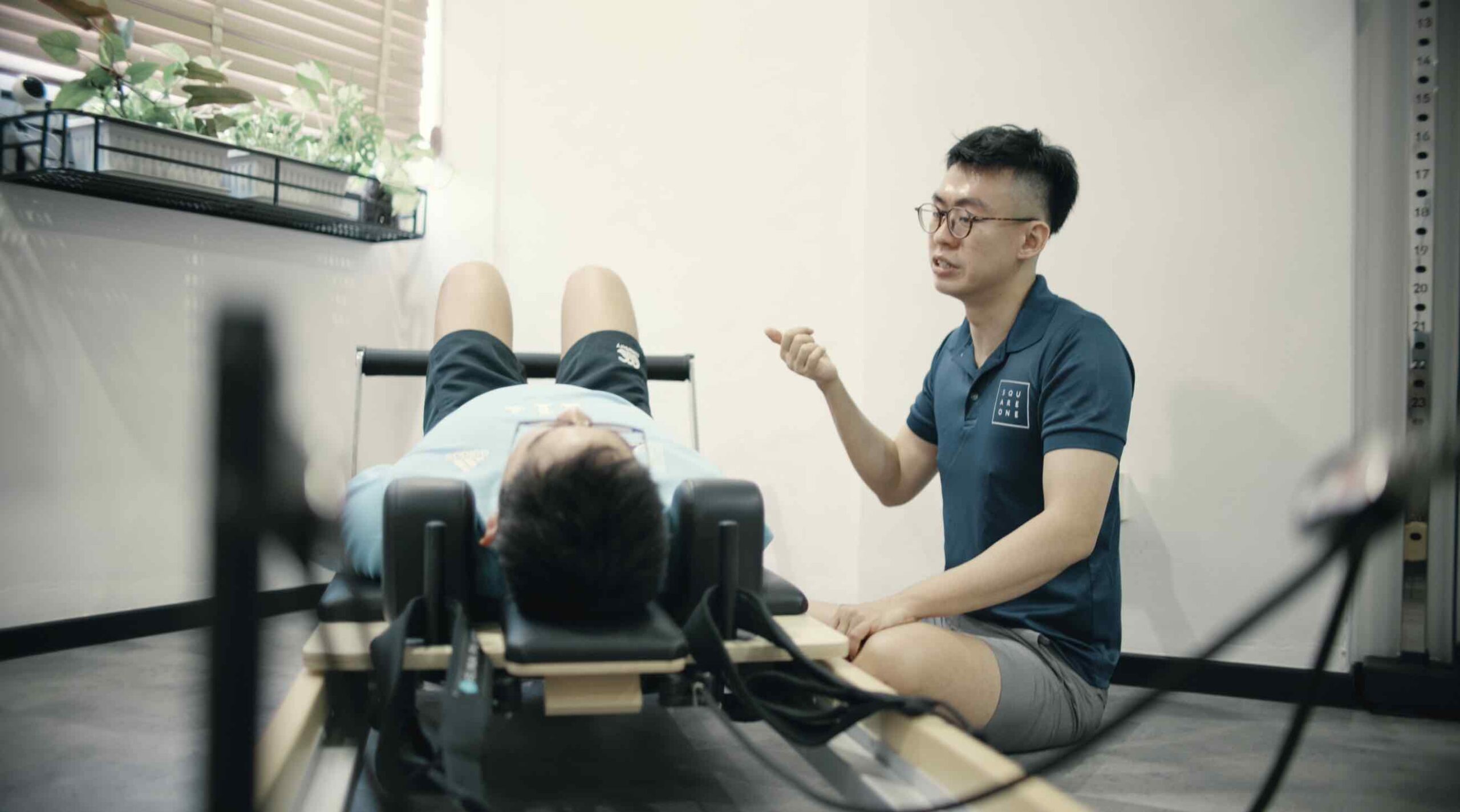
Pilates to Restore Movement Without Fear
When back pain strikes, the natural reaction is to stop moving. Over time, this fear of movement leads to chronic stiffness, joint restriction, and loss of range of motion.
- How it helps: Our Clinical Pilates and targeted mobility and flexiblity sessions provide a safe, structured environment to restore fluid joint movement, improve range of motion, and reduce movement anxiety.
- Who it is for: It is the ideal starting point for desk workers suffering from stubborn daily stiffness, serving as a gentle yet effective bridge before progressing to higher load exercise.
Strength Training to Build High Capacity Resilience
Sitting at a desk for 8 to 10 hours a day is a physical endurance event. For those who prefer a direct, strength based approach rather than focusing on flexibility or mobility, progressive strength training is the gold standard for long term spinal support.
- How it helps: We utilise evidence based strength training protocols, focusing on posterior chain development, heavy glute recruitment, isometric stabilisation, and compound resistance, to systematically increase your load tolerance. By strengthening the structural muscles surrounding your spine, we ensure your tissues can easily absorb the daily stresses of prolonged sitting without breaking down.
- Who it is for: Ideal for individuals who want a robust, strength focused rehabilitation program that prioritises physical capacity and muscle endurance over stretching, ensuring your back can comfortably handle demanding workdays and active weekends alike.
Stop Managing Pain. Start Resolving It.
You do not have to accept lower back pain as an unavoidable cost of a desk job. Whether you are recovering from a painful flare up or looking to safeguard your spine for the long run, our tailored programs are designed to help you achieve lasting, long term independence.
Key Takeaways
Consider these key points when managing desk related lower back pain:
-
1
Chairs Are Not Medical Devices: The ergonomic chair market is unregulated and postural ideals are rarely evidence based. Furniture alone cannot cure back pain.
-
2
Sitting Stalls Physiology: Prolonged static sitting causes muscular deactivation, sluggish blood flow, elevated inflammatory markers, and sustained disc compression.
-
3
Movement Breaks Static Load: Breaking up sitting every 30 to 45 minutes and introducing movement variety helps stimulate local blood flow and reduce stiffness.
-
4
Capacity Over Passive Support: Lasting relief comes from active rehabilitation, whether through Clinical Pilates or targeted strength training to build real physical resilience.

