
When you’re working through a rehabilitation program, it’s natural to focus on the numbers: How many reps? How much weight? But one of the most common questions we get at Square One Active Recovery is surprisingly simple: “How long should I be resting between my sets?”
If you are looking for a rigid, one-size-fits-all rule, we have bad news: rehab doesn’t work that way. Here is our primary guiding principle for rest, how rest times interact with fatigue and tissue capacity, and why taking a break is sometimes more about your brain than your muscles.
1. The Golden Rule: Rest as Long as You Need
Our baseline guiding principle for rest periods is simple: Rest as long as you need to complete the next set with good form and quality.
Rehabilitation isn’t about pushing yourself to complete exhaustion or turning every session into a high-intensity circuit. When working with an evidence-based chiropractor in Singapore, the goal of exercise is restoring function, managing pain, and building strength safely. On average, for standard rehab exercises, rest periods range between 1 to 3 minutes:
- 1 to 2 minutes: Great for light isolation work or motor control drills.
- 2 to 3 minutes: Ideal for heavier loading and compound movements aimed at building structural strength.
2. Rest, Fatigue, and Muscle Adaptations
To create physical adaptations in muscles and tendons, like building strength or muscle mass, we need to apply enough mechanical stimulus. Often, that means driving sets close to muscular failure (the point where you physically cannot complete another rep with good form).
Shorter rest periods naturally make an exercise harder and bring you closer to muscular failure faster. However, rushing your rest just to make a set feel harder isn’t always the goal in an active exercise rehabilitation program.
Why You Shouldn’t Just Do “More Sets or More Reps”
It can be tempting to feel good during a session and decide to perform extra reps, extra sets, or cut rest times to zero. But in a rehab context, exercise volume is strictly prescribed based on your tissue capacity and tissue sensitivity.
Your exercise prescription is given based on what we observe and assess during your session. It is calculated to give you the maximum therapeutic benefit while being the least likely to aggravate your symptoms or cause flare-ups. Pushing past your prescribed volume doesn’t speed up recovery, it risks overloading tissues, over training injuries, and may delay progress.
Why Do Muscles Tremble or Shake During Pilates?
Have you ever felt your legs or core involuntarily quivering during a slow, controlled pilates hold or Reformer exercise? This muscle shaking is an physiological phenomenon caused by your nervous system.
Muscles contract by recruiting individual motor units (a nerve and the muscle fibers it activates). Normally, your brain fires these motor units asynchronously (i.e., some contract while others rest) to create a smooth, fluid movement. However, during sustained holds in pilates, yoga, or calisthenic body weight exercises, your motor units tire out, forcing your brain to rapidly recruit secondary muscle fibers to maintain position.
As fatigued motor units drop out and new ones fire, muscle contractions temporarily lose their smooth synchrony. This rapid alternating cycle of micro-contractions and relaxations causes that distinct shaking sensation! It is not a sign of weakness or injury but an active neuromuscular fatigue and motor unit adaptation.
3. Match the Rest to the Intent of the Exercise
To know how much rest you need, you have to look at the intent of what you are training for in each specific movement:
| Exercise Goal | Primary Intent | Typical Rest Strategy |
|---|---|---|
| Motor Skill Acquisition | Teaching your nervous system a new movement pattern | Micro-dosed throughout the day (Hours between reps) |
| Balance & Neuromuscular Control | Resetting nervous system & emotional state | Strict rest between sets (Even if physically un-tired) |
| Endurance & Tissue Capacity | Building local stamina in target muscles and tendons | Short to Moderate rest (60–90 seconds) |
| Strength & Heavy Loading | Increasing force production and mechanical capacity | Longer rest (2–3+ minutes) |
4. Motor Skill Acquisition: The “Spread-It-Out” Approach
When the goal of an exercise is developing motor skills or rebuilding trust in a movement pattern, traditional set-and-rep structures (e.g., 3 sets of 10 with short rest) aren’t always optimal. High physical or neural fatigue actually interferes with motor learning.
Instead of doing all your reps in a single block, we often emphasise higher frequency with very long rest periods. For example, instead of performing 15 reps all at once, you might perform 2 to 3 reps multiple times throughout the day, leaving hours of rest between mini-sets.
Our highest frequency prescription is to do an exercise every 2-3 hours!
This high-frequency, micro-dosed approach gives your brain and nervous system fresh, repeated exposures to the movement pattern without accumulating fatigue, speeding up skill acquisition significantly.

5. Balance Exercises: Resting for the Brain, Not Just the Body
Sometimes, rest is not for physical exertion. It is to reset the brain and emotional state.
During balance or complex neuromuscular drills, clients generally feel flustered or mentally drained after being sufficiently challenged, even if their muscles aren’t burning and their heart rate is low. If you don’t take enough rest between balance sets, balance performance for progress reps will decline very rapidly.
What you practice grows stronger. Forcing your way through balance sets while flustered means doing poor-quality reps, which can develop more of a flustered-ness response and actually contribute to a roadblock or bottleneck in recovery. In this case, even though you aren’t physically tired, adhering strictly to the prescribed set and rep arrangement and taking full rest breaks is preferred.
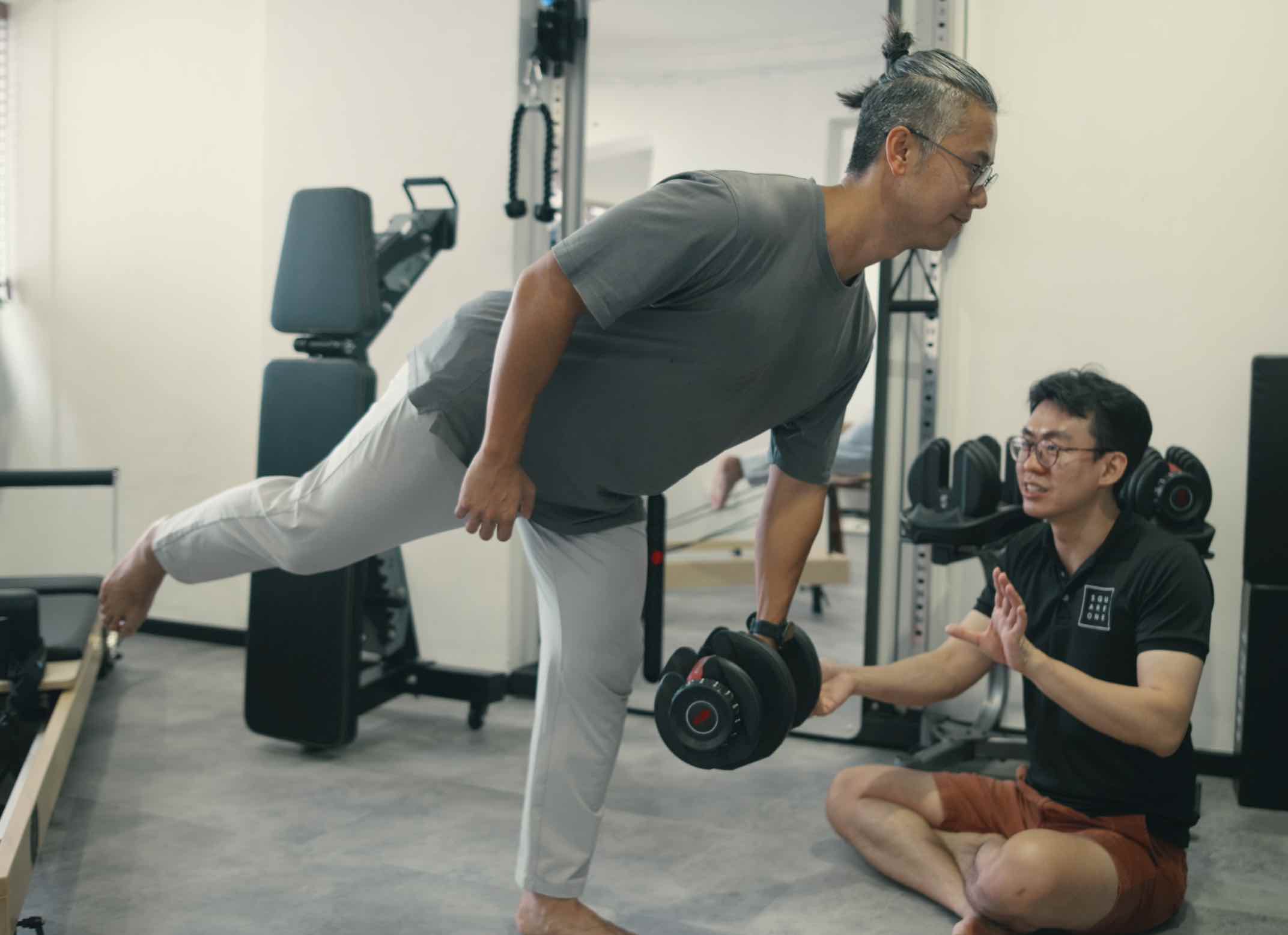
6. Key Takeaways for Your Rehab Sessions
Knowing how to manage your rest periods ensures every set delivers the maximum physical and neurological benefit for your recovery.
Key Takeaways
Keep these core principles in mind when executing your rehabilitation exercises:
-
1
Rest for Quality: Rest as long as needed to execute the next set with good movement quality and form rather than rushing against the clock.
-
2
Respect the Prescription: Avoid arbitrarily adding extra reps or sets. Your program is strictly calibrated to match your current tissue capacity and sensitivity.
-
3
Reset Your Brain: On balance and motor skill drills, rest intervals prevent mental frustration and sloppy reps, reinforcing positive neural adaptations.

