
When scrolling through fitness social media, you’ll likely see endless advice about keeping a flat, rigid back during the deadlift. If your spine rounds ever so slightly, the comment section is quick to sound the alarm: “Fix your form,” “You’re going to herniate a disc,” or “Drop the weight.”
But what if fixing that round back isn’t entirely up to you? The truth about human biomechanics is far more nuanced than a rigid rulebook. Technique isn’t a one-size-fits-all aesthetic mold. It is about lifting safely and efficiently given your current physical reality. Good technique doesn’t always have to look aesthetic. Understanding why a rounded back happens and knowing the difference between functional deficits and structural limitations can change how you approach the lift entirely.
1. Functional Deficits vs. Structural Changes
To understand why a round back occurs, we first have to separate what can be trained from what is built into the skeleton on a bone and joint level.
Structural Changes (Bone & Joint Level)
Structural causes of a round back (hyperkyphosis) are rooted in the anatomy of the spine itself. These are structural changes happen on a bone or joint level and can limit how straight the spine can physically become. Common causes of true structural kyphosis include:
- Scheuermann’s Disease: A developmental condition where the vertebrae grow unevenly during adolescence, creating a wedge shape that results in a pronounced structural kyphosis.
- Multiple Compression Fractures: Often resulting from osteoporosis or trauma, these cause vertebrae to collapse or wedge downward, permanently altering spinal curvature.
- Ankylosing Spondylitis or Chronic Degenerative Changes: Inflammatory or degenerative conditions where vertebrae can fuse or stiffen into a flexed posture.

Functional Deficits (Strength & Stability)
Functional limitations, on the other hand, stem from a lack of back extensors or deep spinal stabilisers to maintain a neutral or more neutral spine under load:
- Bodyweight or Light Loading: If someone loses a neutral spine during an unweighted or light deadlift (assuming passive mobility tests show full spinal flexion and extension) it isn’t a structural restriction. It’s a lack of psychomotor control or hip hinge technique. The body simply hasn’t learned how to coordinate the movement pattern under load yet.
- Loaded Breakdown: If you start to lose a neutral spine as the bar gets loaded up, it’s because your extensors or stabilisers cannot support the heavier weight yet. It is a strength and condition issue.
2. Prevention vs. Management: Can Exercise Stop Structural Changes?
When looking at structural conditions like compression fractures or progressive kyphosis, a common question arises: Can exercise prevent this entirely?
The honest answer is no, exercise cannot meaningfully reverse structural changes. Systemic disease processes, genetics, hormonal shifts, and severe trauma play major roles in structural spinal changes that no training program can completely override. However, prevention is still infinitely better than cure.
While exercise cannot guarantee 100% prevention, smart, progressive loading and staying active can significantly reduce the risk of developing a structural change or reduce the extent to which it may occur.
Why Being Sedentary Is Always Worse
Even if exercise doesn’t offer 100% protection, doing nothing is far more damaging. A sedentary lifestyle only speeds up physical decline.
- Accelerated Bone Density Loss: Bones require mechanical stress to maintain density (Wolff’s Law). Without load-bearing movement, bone breakdown outpaces formation, leaving trabecular bone fragile and far more prone to compression fractures.
- Loss of Muscular Brace: Without active back extensors and core stabilisers constantly working, the muscular support surrounding your spine wastes away, leaving passive structures to take the brunt of daily gravitational loads.
- Connective Tissue Stiffening: A sedentary spine loses its articulation. Spinal discs depend on movement for nutrient exchange. Sitting all day can accelerate disc degeneration and structural stiffening.
3. Structural vs. Functional Deadlift Management
How you approach and adjust your deadlift strategy depends entirely on whether your rounded back is driven by tissue capacity or anatomical bone structure:
| Curvature Type | Mechanism | Action Strategy |
|---|---|---|
| Functional Deficit | Inadequate extensor endurance or stabilisation strength under load | Manage weight load, integrate accessory extensor work, and train stabilisation in flexion |
| Structural Changes | Vertebral wedging, compression fractures, or ankylosing changes | Maintain daily mobility work, work with natural roundness, focus on technique over (aesthetic) form |
4. The Powerlifting Reality: Is Flexion Always Bad?
Elite strength sports present a very different picture. In powerlifting, spinal flexion during maximal deadlifts is often intentional.
Biomechanical studies confirm that a flexed spine is actually stronger in certain contexts. A slightly rounded upper back shortens the moment arm from the barbell to the hips, improving leverage and allowing lifters to pull maximal weight efficiently.
In fact, research shows that a flexed spine is actually stronger because of the mechanical advantage. Studies by Mawston et al. (2021) and Dolan et al. (1994) found that flexing the back slightly places your back muscles at a better angle to pull, giving them more leverage to produce strength. At the same time, your spinal ligaments and connective tissues stretch to act like elastic bands, helping your muscles lift heavier weights with less effort.
Technique is far more complicated than chasing an ideal visual standard. It’s about being able to lift safely and efficiently given your current situation and condition. Good technique doesn’t have to look aesthetic to be functional and effective.
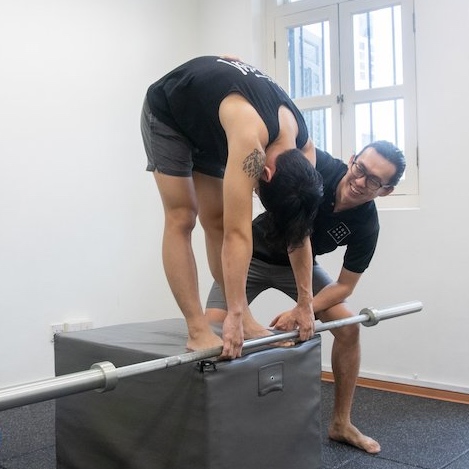
5. How to Manage Your Deadlift
Regardless of the underlying cause, do the best you can with the body you have. How you manage a rounded back simply depends on which category you fall into:
If Your Round Back Is Due to a Functional Deficit
Integrate accessory exercises to improve both spinal mobility and stabilisation in flexion. Because there is indeed a deficit, it’s best not to load too much weight right away. Build stabilisation and strength progressively before chasing heavy singles.
If You Are Rounded Because of Structural Reasons
Even if bone shape prevents a completely flat spine, don’t skip the mobility part. Keep working on getting the spine to move more. Daily practice helps immensely. The objective is not to achieve a neutral spine, but to get the spine moving and healthy.
When deadlifting, you will have to work with the roundness rather than fighting your own anatomy. Shift your focus away from rigid form ideals and concentrate on solid technique by leveraging your setup so you can pull safely and efficiently.
Key Takeaways
Keep these core principles in mind when evaluating spinal posture during the deadlift:
-
1
Differentiate Structure vs. Function: Structural kyphosis (e.g., Scheuermann’s, fractures) is fixed at the bone/joint level, whereas functional rounding stems from lack of back extensor and stabiliser strength.
-
2
Active Prevention Matters: Exercise cannot guarantees 100% protection against structural changes, but regular loading reduces risks. Being sedentary accelerates bone density loss and structural collapse.
-
3
Technique Over Aesthetics: Good technique is about lifting safely and efficiently for your current physical reality. It is not forcing an aesthetic flat back when biomechanics and powerlifting studies prove flexion can be strong.

