
When you experience a stubborn neck pain flare-up, early retirement feels like the ultimate escape. The logic feels simple: leave the job and leave your pain behind.
To determine whether retirement actually cures desk-related neck pain, we need to examine the problem through a comprehensive biopsychosocial lens. By looking at how tissue tolerance, physiological stress, sleep science, lifestyle factors, and social health interact, we will be able to ascertain if retirement is what you need for long-term neck pain relief.
At Square One Active Recovery, our approach focuses on understanding why desk strain occurs and how active recovery helps you build long-term physical resilience.

1. Why does desk work cause neck pain and stiffness?
Prolonged sitting at a computer involves hours of sustained head positioning. Your neck muscles, the deep neck flexors, act as dynamic postural stabilisers. When they lack sufficient endurance, they fatigue under prolonged static loads.
Prolonged static sitting at your desk without movement also independently triggers irritation and low-grade local inflammation. This is not unique to desk work. You may have also experienced it during long-haul flights (such as traveling economy or budget out of Changi Airport), where even individuals with healthy, pain-free necks experience stiffness from hours of immobility.
Biological Perspective
- Mechanical strain & tissue capacity: Prolonged static positioning without movement triggers low-grade local inflammation. When deep neck flexor endurance is low, tissues struggle to tolerate hours of desk posture.
- Joint health & cartilage loading: Articular cartilage has virtually no direct blood supply. It cannot receive nutrients through blood flow and relies on movement and mechanical loading to compress and release the joint to pump fresh nutrients in and flush waste out. A sedentary lifestyle without this pumping action causes joint health to deteriorate over time.
Psychological Perspective
- Stress & cortisol: High-pressure professional environments elevate systemic cortisol levels, upregulating inflammatory markers and increasing overall neural susceptibility to pain.
- The sleep-pain loop: Desk strain and job stress frequently disrupt sleep quality, contributing to central sensitisation and amplifying pain intensity.
- Hyperfocus & delayed pain awareness: Getting deeply absorbed in high-focus work often causes people to lose track of time and stay completely still for hours. During this period, neck muscles remain locked in continuous static contraction while joints are held without movement. By the time you finally snap out of hyperfocus and attempt to turn or stretch, it feels “too late”. The accumulated muscle strain and joint stiffness immediately trigger sharp, sudden pain.
Social Perspective
- Workplace social stress & pain sensitivity: Poor social well-being at work (e.g., toxic social dynamics, feeling unsupported by leadership, or frequent workplace conflict) directly drives up physiological stress. Experiencing chronic social friction or isolation in the office reduces your emotional buffering capacity, leaving the nervous system hyper-vigilant and making your body significantly more sensitive to physical pain.

2. Does stopping work actually cure chronic neck pain?
With all of these contributing factors in mind, retirement sounds like the ultimate solution. However, aggravating factors are not root causes.
Just because work makes your neck pain worse, which is very common, it does not mean work causes your pain.
Stopping work can very much result in an initial symptom improvement because you remove immediate aggravators. However, given enough time away from work, if underlying vulnerabilities remain unaddressed, the pain inevitably creeps back.
Most neck pain risk factors are lifestyle-related, not strictly work or desk related.

3. How can desk workers fix persistent neck strain?
To bridge the gap between temporary relief and long-term resilience, addressing specific physical and behavioral variables is far more effective than simply changing employment status:
| Risk Factor or Driver | Targeted Strategy |
|---|---|
| Sedentary lifestyle | Increase general daily movement, physical activity, and structured exercise. |
| Poor deep neck flexor endurance | Implement targeted cervical flexor strengthening and motor control drills. |
| Scapular winging or muscle atrophy | Strengthen the serratus anterior and surrounding scapular stabilisers. |
| Prolonged static posture | Introduce micro-breaks, position shifts, and dynamic seating options at work. |
| Unnoticed postural creep | Practice mindfulness and body awareness to reset tension during high-focus tasks. |
| Poor sleep and stress | Optimise sleep hygiene routines, stress management tools, and cardiovascular exercise. |
| Poor joint health (degenerative changes) | Use progressive weighted exercise to stimulate collagen synthesis, tissue remodeling, and nutrient exchange. |
| Restricted neck mobility | Incorporate gentle range-of-motion and movement practices like clinical Pilates. |
4. Is retirement really the answer for neck pain?
Retirement is not the ultimate solution to neck pain. It does provide immediate symptom relief by removing daily workplace triggers, offering a helpful window of opportunity to work on your recovery.
However, most people who take time off work (either in full or in part) tend to see virtually no long-term improvement in their condition after a few months. Why? Because while the rest feels much needed and temporarily reduces symptoms, underlying lifestyle stressors and deconditioning soon creep back in through other daily activities.
Worse yet, if you stop work and remain sedentary, you risk accelerated physical deconditioning, sometimes making it even harder to return to work or enjoy active pursuits later.
Ultimately, work is not the deal-breaker. Retirement offers comfort, but it does not on its own improve neck health or long-term functional outcomes. Real freedom comes from building a resilient body that isn’t afraid of sitting, working, or moving.
5. How to treat desk neck pain in Singapore
At Square One Active Recovery in Chinatown, Singapore, we completely appreciate that chronic pain recovery is about lifestyle changes. Everyone knows exercise is important, but knowing that as a fact and getting to the point to start exercising is a big gap. Even after starting to exercise, being able to maintain it as a lifestyle is a completely different challenge.
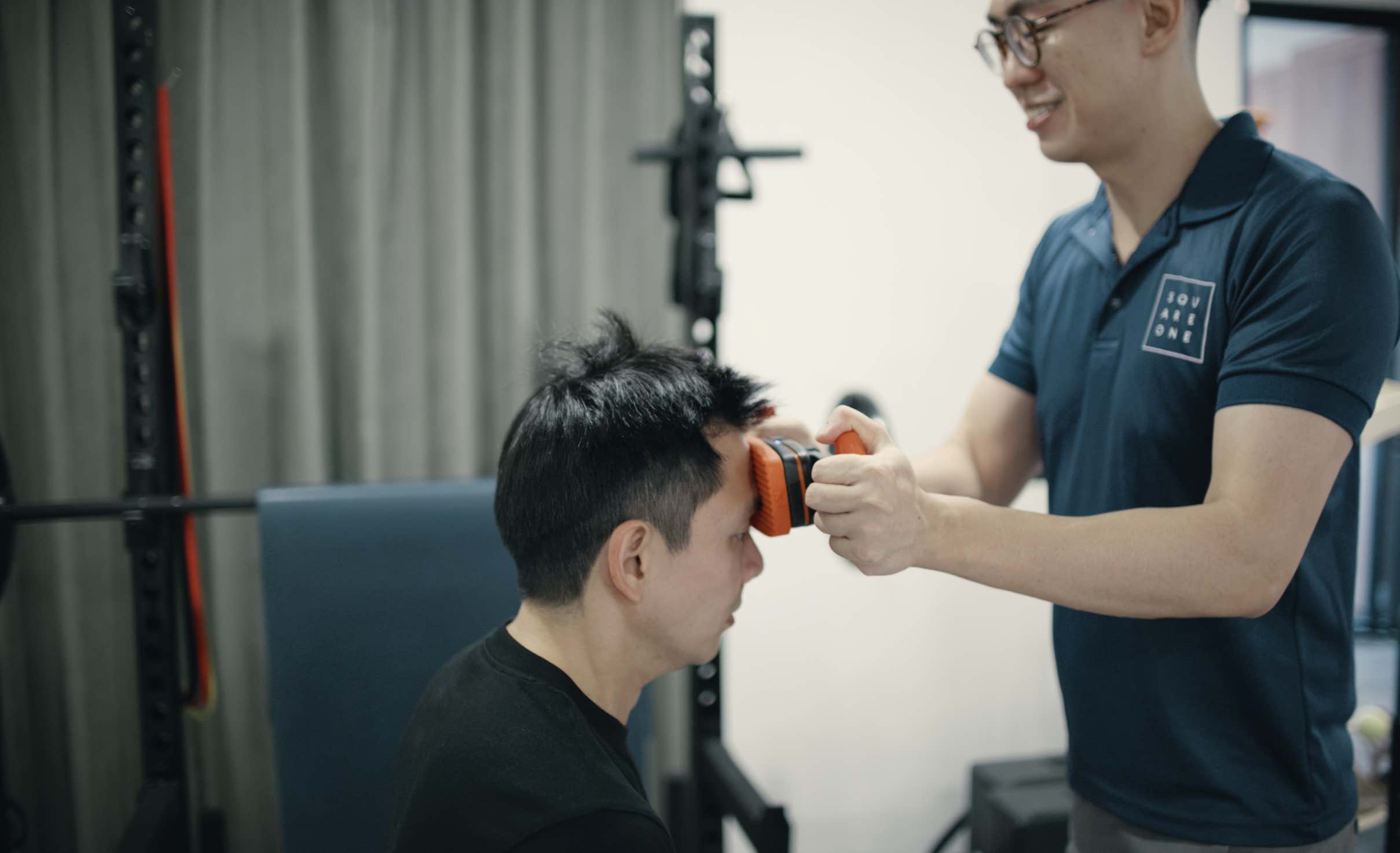
That is why at Square One Active Recovery, we take a whole-person approach to chronic pain. On top of expertise as a chiropractor to treat spinal pain, Jesse Cai is also a Certified Solution-Focused Coach, a contributing author to the chapter on chronic pain in Solution-Focused Coaching in Asia (Routledge, 2025), and is completing his studies in psychology at James Cook University. Through tailored Clinical Pilates and progressive rehab training at our private home studio, we systematically restore neck endurance, improve joint health, and bulletproof your posture so you can tolerate daily demands without fear of flare-ups.
Key Takeaways
Keep these essential principles in mind when addressing desk-related neck strain:
-
1
Active Recovery Focus: True care empowers you with movement capacity and strength rather than trapping you in passive symptom management.
-
2
Aggravation vs. Causation: Work makes pain worse, but it rarely causes it; stopping work provides temporary relief without fixing underlying lifestyle drivers.
-
3
Whole-Person Approach: Bridging the gap from knowing exercise is important to building a lasting physical routine requires expert coaching and motor control.

