
💡 At a Glance: Deadlifting for Back Pain
-
The Myth: For decades, we were told to “rest and avoid heavy lifting” to protect our backs.
-
The Reality: Avoidance leads to atrophy. In 2026, clinical evidence shows that controlled loading is the fastest path to rebuilding a resilient spine.
-
The Mechanism: Through mechanotransduction, deadlifting signals your body to remodel collagen, strengthen deep spinal stabilizers, and improve disc health.
-
The SQ1 Approach: We don’t just hand you a barbell. We use Orthopedic Testing and a Graded Exposure Protocol to find your “therapeutic dose” of movement.
-
The Goal: To transition you from “protecting your back” to trusting your back. We give you the capacity to handle daily life and heavy gym sessions without fear.
If you are experiencing chronic low back pain or sciatica, picking up a barbell probably feels scary or even dangerous. For decades, the standard medical advice for back pain was to “rest and avoid heavy lifting.”
However, in 2026, clinical evidence has turned this advice on its head. Major clinical guidelines now recommend exercise as first-line treatment over surgery or long-term medication. We now know that avoidance leads to atrophy, and rest often prolongs disability.
As a rehab chiropractor, I don’t see the deadlift as just a “gym move.” I see it as a fundamental biological movement for a resilient spine.
The Clinical Case for Loading Through Pain
The short answer is yes.
In the absence of red flag symptoms (detailed below), you should not only continue to deadlift, but you should view the movement as a potential tool for your recovery. The common instinct to “rest” or “avoid lifting” is often what traps patients in a cycle of chronic pain. When you stop loading your spine, your tissues become deconditioned, your nervous system becomes hypersensitive, and your overall capacity (i.e., envelope of function) shrinks.

Research published in The Lancet highlights that physical inactivity is a leading driver of persistent musculoskeletal disability.
At Square One Active Recovery, we don’t ask if you should deadlift. We ask how to to get you started to deadlift safely.
Mechanotransduction: How Load Rebuilds the Spine
Why is lifting weight the solution to a back injury? The answer lies in a cellular process called mechanotransduction.
Mechanotransduction is the mechanism by which your body converts a mechanical stimulus (the stress of a deadlift) into a biological healing response. When you perform a deadlift, the physical load stretches and compresses your cells, triggering a cascade of biochemical signals.

-
Collagen Remodeling: Mechanical stress signals fibroblasts to lay down new, organised collagen fibers. This effectively “thickens” and reinforces your spinal ligaments and tendons.
-
Muscle Hypertrophy: It targets the lumbar multifidus and deep stabilising muscles of the spine. Research shows these muscles often atrophy in chronic pain patients. The deadlift, when use correctly, can be an effective way to “wake them up.”
-
Disc Health: Controlled loading assists in nutrient exchange within the intervertebral discs, acting as a “pump” to move essential fluids into the disc space. This helps with healing and can even prevent spinal diseases.
What Exactly is a Deadlift?

In the simplest terms, a deadlift is the act of picking a “dead” weight (a weight that isn’t moving) up off the floor and standing up with it. From a biomechanical perspective, it is a hip-hinge dominant movement. It primarily targets the posterior chain, which is the network of muscles including your glutes, hamstrings, and the erector spinae.
In a rehab context, we view the deadlift as a fundamental functional movement pattern. Whether you are picking up a grocery bag, a laundry basket, or a child, you are performing a dynamic variant of a deadlift. If you “can’t deadlift,” you technically cannot function safely in daily life. Maintaining functional strength is critical for long-term health and is aligned to health initiatives by the Singapore government.
1. Healthier SG & The National Strategy for Population Health
The deadlift directly supports the Healthier SG initiative, which shifts the focus from reactive healthcare to preventive care. By mastering functional movements, you can reduce the risk of chronic musculoskeletal issues and frailty.
2. The 2023 Action Plan for Successful Ageing
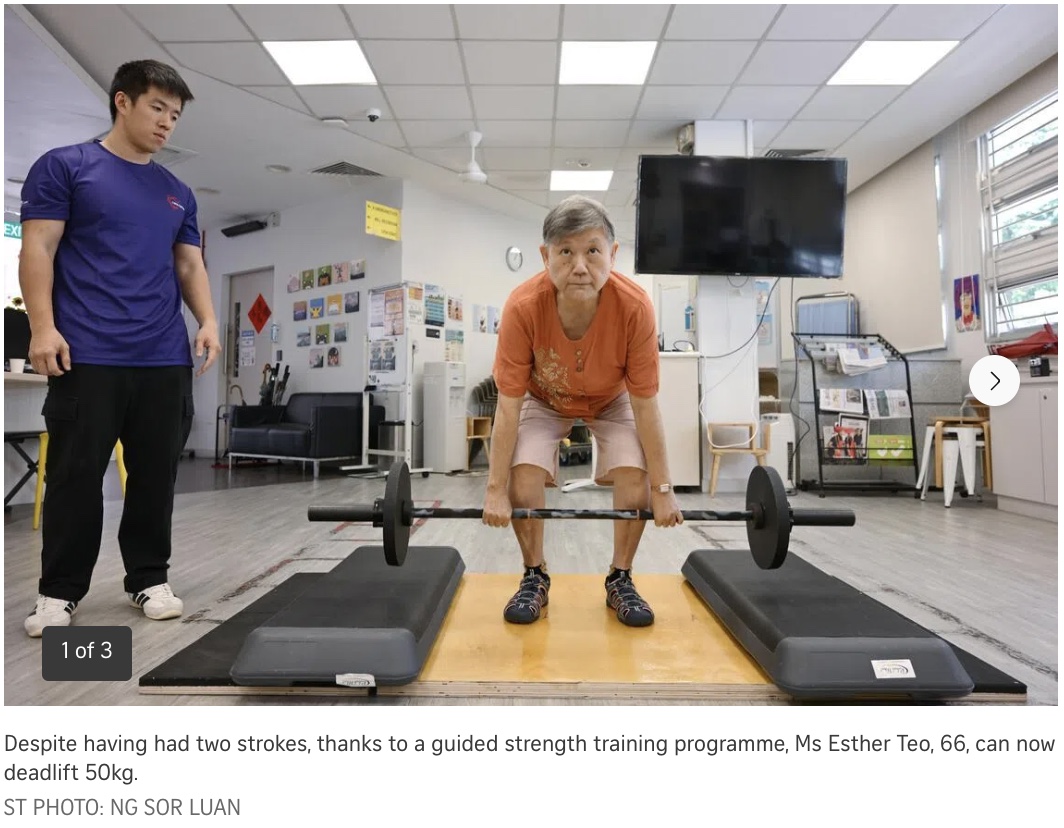
Singapore’s 2023 Action Plan for Successful Ageing highlights exercise not just as a hobby, but as a critical pillar for maintaining physical independence. However, the definition of “staying active” is shifting away from evening walks toward a more robust paradigm: Strength Training.
As reported by The Straits Times, there is a growing movement of seniors in Singapore, some in their 70s and 80s, who are “raising the bar” by trading resistance bands for barbells.
-
Combatting Sarcopenia: The plan emphasises the need to fight muscle loss (sarcopenia) and frailty. Deadlifting is a proven way to build the bone density and muscle mass required to prevent falls.
-
Beyond Cardio: While cardiovascular health is important, the current national push encourages seniors to engage in resistance exercises that challenge their limits. As one 72-year-old lifter noted, “strength training makes me feel empowered, not just active.”
At Square One Active Recovery, our protocol aligns perfectly with this national shift. We believe that aging shouldn’t mean a “shrunken” envelope of function. By applying the same deadlift mechanics used by athletes, we help Singapore’s seniors build a “support system” of muscle that keeps them resilient well into their 80s and beyond.
What to Do if Your Deadlift Hurts
In contemporary rehabilitation, experiencing “pain” during a movement is not an automatic signal to quit. In fact, total cessation of an exercise can often impede recovery by allowing the tissues to further decondition. If you find your deadlift is triggering discomfort, you can try to modify the load or mechanics rather than abandon the lift entirely.
To help my patients navigate this safely, I use a “traffic light” system:
-
Green Light (0-3/10): Continue as planned but with extra caution. If pain does not improve over the next 2-3 training sessions, consult with your clinician.
-
Yellow Light (4-5/10): Modify the exercise. If pain persists over the next 2-3 training sessions, consult with your clinician.
-
Red Light (>6/10): Stop and consult your clinician.
If you hit a “Yellow Light” during your session, you don’t need to pack your bags and head home. Instead, you should apply a regression. In clinical rehabilitation, a regression is not “taking a step backward”; it is an intelligent modification that reduces the mechanical stress on sensitive tissues while maintaining the stimulus for healing.
Deadlift tips for a painful low back
1. Reduce the Range of Motion: The Rack Pull
One of the most effective regressions for back pain is modifying the conventional deadlift into a Rack Pull.
A rack pull is essentially a deadlift performed with the barbell starting from an elevated position, usually on the safety pins of a power rack or on sturdy blocks, rather than the floor.
-
The Logic: Most back pain is triggered at “end-range” (the bottom of the lift) where the lumbar spine is under the most tension. By elevating the starting position, we shorten the range of motion. This allows you to train the “hinge” pattern and load your glutes and hamstrings without hitting that painful “bottom” position. It builds confidence by proving you can still lift heavy weight safely.
2. Shift the Center of Mass: The Trap Bar (Hex Bar)
If the barbell is still causing a “Yellow Light,” the next regression is to change the equipment. Switching to a Trap Bar (a hexagonal bar you stand inside) is a game-changer for spinal rehab.
-
The Logic: In a conventional deadlift, the bar is in front of you, creating a longer “lever arm” that increases the stress on your lower back. By stepping inside the frame of a hexagonal bar, you move the load closer to your center of gravity. Research shows this significantly reduces the “shear force” on the L4/L5 and L5/S1 discs, making it a much friendlier option for those with disc sensitivities.
3. Check Your “Bracing” Strategy: Intra-Abdominal Pressure (IAP)
Sometimes the solution isn’t in the movement but in the internal support. Some patients “suck in” their stomach to protect their back during a deadlift. This is actually a mistake that can increase spinal sensitivity.
-
The Logic: Instead of pulling your belly button to your spine, use the Intra-Abdominal Pressure (IAP) approach. Imagine your torso is a soda can; a hollow can is easy to crush, but a pressurised one can withstand a lot more load.
-
The Fix: Breathe deep into your “sides” and “back” (360-degree expansion) and brace your core as if someone is about to punch you. This creates a natural, internal “airbag” that supports the vertebrae from the inside out and provides the stability you need for a deadlift.
Deadlifting: Rehab Chiropractor vs. Personal Trainer

A common question we hear at Square One is: “Why can’t I just learn this from a personal trainer?”
The difference lies in training and expected outcomes. A trainer focuses on fitness goals (lifting more weight). A rehab chiropractor focuses on clinical outcomes (reducing pain and restoring function).
-
Differential Diagnosis: As a chiropractor, I possess the clinical training to distinguish between adaptive and maladaptive pain. Understanding this distinction is the difference between pushing through a necessary stimulus and inadvertently aggravating an injury.
-
Dose Control: In a rehabilitation context, exercise is medicine. There is dose limit and a therapeutic dose. As a clinician, I calculate the precise volume (sets/reps) and intensity (load) required to trigger a healing response through mechanotransduction. I monitor your 24-hour symptom response to ensure the ‘dose’ was therapeutic rather than provocative.
-
Biomechanical Modification: Not all back pain is the same. I modify the leverages, joint angles, or tempo of the lift based on your specific clinical presentation and biomechanics. For example, the movement strategy for a disc-related protrusion requires a significantly different mechanical setup than a regression for facet joint irritation or spondylolisthesis.
Clinical Red Flags: When to Seek Medical Attention
As a chiropractor, my first priority is safety. While loading is beneficial for the majority, it is contraindicated if you are experiencing red flag symptoms. You should seek an immediate medical attention if you experience:
-
Progressive Neurological Deficits: Sudden weakness in your legs (e.g., foot drop) or inability to stand on your toes/heels.
-
Saddle Anesthesia: Numbness or tingling in the groin, “saddle” area, or inner thighs.
-
Bladder/Bowel Dysfunction: Any sudden change in your ability to control or start urination/bowel movements.
-
Unrelenting Night Pain: Constant, severe pain that prevents sleep regardless of position.
-
Recent Fracture or Malignancy: Known spinal fractures or active bone-related pathologies.
Note: Having a diagnosed “slipped disc” or “sciatica” is not a reason to avoid deadlifting. These conditions can benefit from light to moderate deadlifting under the supervision of a chiropractor.
The SQ1 Protocol: A Graded Exposure Model
Your starting point is dictated by your exercise history and injury. We don’t waste a powerlifter’s time with air hinges, nor do we rush a sensitised patient onto a barbell.
Our SQ1 Protocol is a clinical framework that use Graded Exposure to systematically bridge the gap between where you are now and where you want to be. Deadlifting may not be your exercise of choice but can be the tool that can get you to picking up your groceries without fear.

-
Stage 1: The Hip Hinge (Unloaded) For those with high neural sensitivity, fear of bending or poor movement technique, we start with learning to move from the hips while keeping the spine stable before adding weight.
-
Stage 2: The Romanian Deadlift (RDL) We prioritize the eccentric (lowering) phase of the movement. By slowing down the descent, we emphasise “time under tension.” This is a clinical strategy used to remodel the lumbar fascia and desensitise the nervous system. It essentially “reprograms” the brain to accept load without triggering a protective muscle spasm
- Stage 3: Elevated Pulls (Dumbbell or Plates) Starting with the weight on blocks to shorten the range of motion. This avoids the sensitive “bottom” position while still triggering a healing response.
-
Stage 4: Conventional Loading Full-range barbell loading. This is the destination for experienced lifters or the final stage of rehab, ensuring your physical capacity far exceeds your daily demands.
Stop Overprotecting Your Back and Start Loading It.
Should you deadlift with back pain? Yes, provided you have a clinical roadmap.
The goal of modern chiropractic care is not to make you a “permanent patient.” It is to make you an athlete of your own life. By using the deadlift as a clinical tool, we help you transition from “protecting your back” to “trusting your back.”
Ready to stop the cycle of temporary relief and start building a resilient spine?
📍 Square One Active Recovery | Raffles Place, CBD
[Book Your Clinical Assessment Today]
BOOK A CHIROPRACTOR IN SINGAPORE
Based in Singapore, Square One Active Recovery offers treatments with a very big difference. With our evidence-based exercise approach, you can achieve your recovery goals in just 12 weeks. Not getting results from your chiropractor, TCM doctor or physiotherapist? Talk to us and find out how we can take your recovery to the next level.
Our goal? To make our own services redundant to you.
*We do not offer temporary pain relief such as chiropractic adjustments, dry needling, or any form of soft tissue therapy.

