
Scapular winging occurs when your shoulder blade detaches from your ribcage. It protrudes like an angel wing instead of sitting flat against your back. This structural shift compromises your entire shoulder girdle and alters how force transfers from your arm to your torso, frequently leading to persistent shoulder pain and functional loss.
Anatomy of Scapular Winging and Muscle Mechanics
Your scapula floats across your ribcage in a region known as the scapulothoracic articulation. Unlike your shoulder joint or your elbow joint, this articulation features no direct bony or ligamentous connection between your shoulder blade and your thorax. Your shoulder blade relies entirely on a muscular sling to stay flush against your back wall.
Your scapula serves as the crucial attachment site for seventeen different muscles. These muscles perform three vital functions:
- They stabilise your scapula securely to your thorax.
- They provide mechanical power and force transfer to your upper limb.
- They synchronise your glenohumeral motion so your arm moves smoothly overhead.
A healthy shoulder blade stays flat against your ribcage through a precise balance of muscular force couples. As you move your arm, multiple muscles pull in opposing directions simultaneously. This coordinated tension pins your shoulder blade firmly against your chest wall.
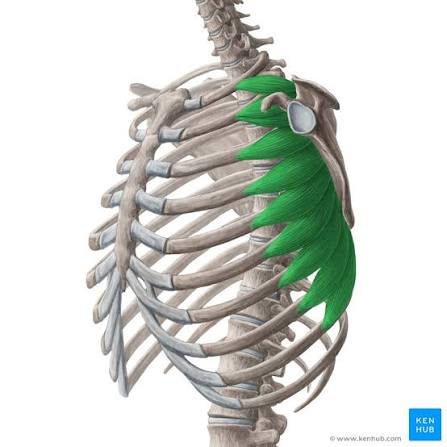
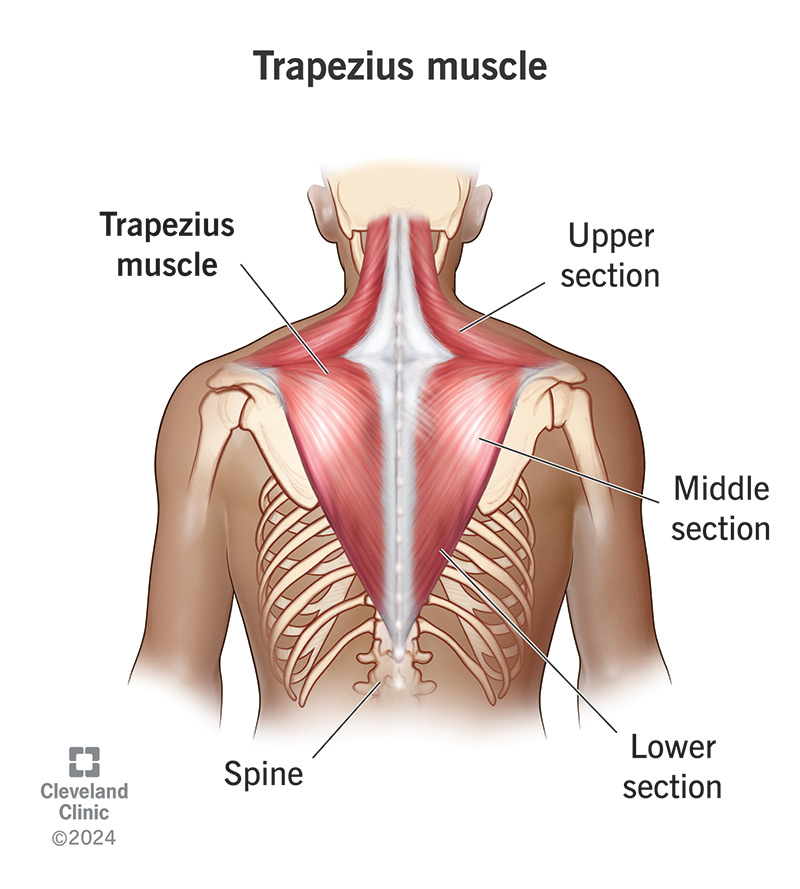
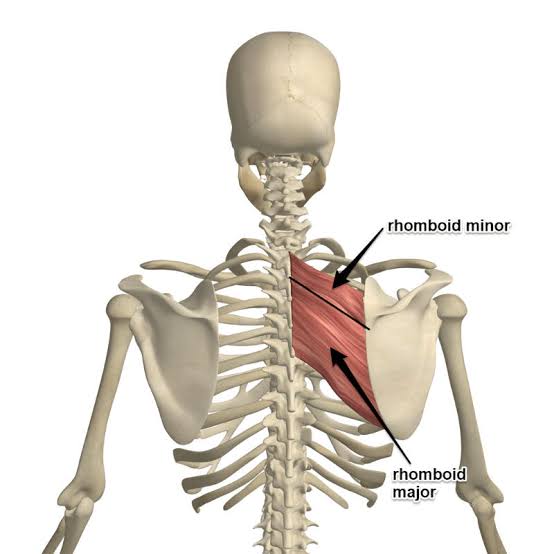
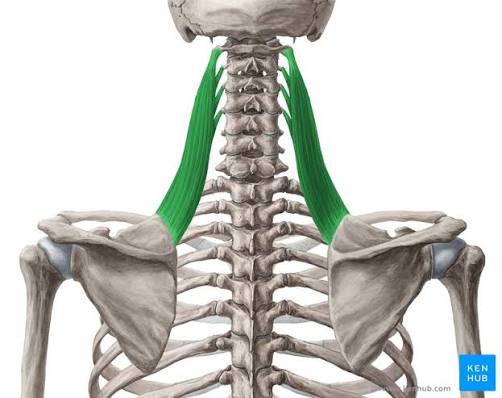
Four primary muscle groups anchor and drive this system:
Understanding Scapular Winging Types and Presentation
Normally, a complex web of muscles anchors your shoulder blade securely to your posterior chest wall. When these stabilising muscles become weak or paralysed, the inner border of your shoulder blade lifts away from your ribcage.
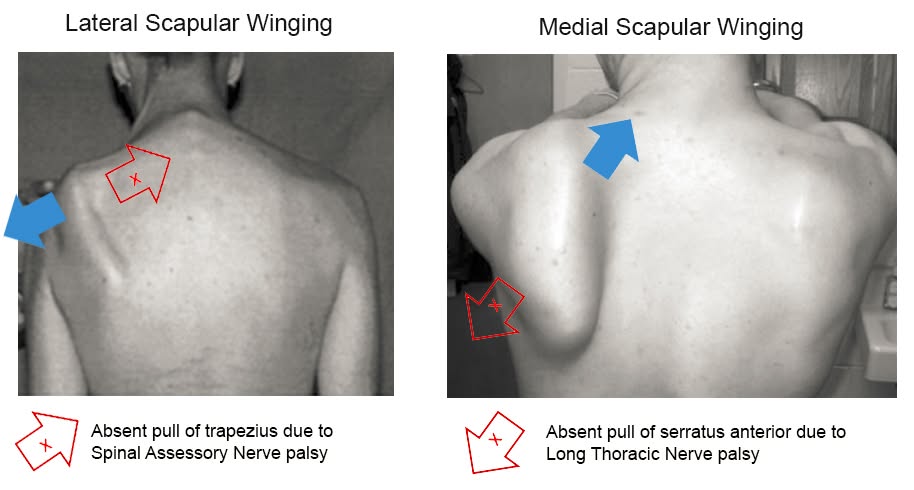
Scapular winging falls into two main types:
- Medial Winging: This is the most common form. Weakness or paralysis of your serratus anterior muscle causes your entire shoulder blade to drift away from your spine and flare backward, creating classic scapular dyskinesia.
- Lateral Winging: This happens less often. Weakness in your trapezius or rhomboids causes your shoulder blade to shift outward and downward.
Causes and Origins of Scapular Winging
Scapular winging stems from acute trauma, repetitive strain, or developmental factors.
Nerve Injury and Trauma
Your long thoracic nerve runs a long superficial course. This makes it vulnerable to compression, heavy backpack strain, sports collisions, heavy overhead lifting, or surgical complications. Blunt trauma or sudden shoulder depression damages the nerve and causes immediate serratus anterior palsy.
Poland Syndrome
Poland Syndrome is a rare congenital condition. It involves the underdevelopment or absence of your chest wall muscles on one side of the body alongside hand anomalies. Compromised chest wall musculature alters your biomechanics and leads to secondary scapular winging.
Spontaneous Development During Puberty
Some teenagers develop medial scapular winging without any history of trauma. This typically coincides with rapid growth spurts during puberty. Bone length increases faster than surrounding nervous tissue and muscle can adapt. This creates transient tension on your long thoracic nerve and causes temporary functional weakness in your serratus anterior.
Functional Limitations in Daily Life
Your shoulder blade acts as the stable base for all upper limb movement. Winging disrupts the precise rhythm required for basic tasks.
- Overhead Reaching: Lifting your arm above your shoulder requires upward rotation of your shoulder blade. Without a stable anchor, your deltoid and rotator cuff lack a firm foundation. This severely limits your arm elevation.
- Lifting and Carrying: Loading your arm downward requires your shoulder blade to lock against your ribcage. Winging causes energy to leak out of your shoulder girdle. This makes heavy carrying fatiguing and inefficient.
- Pushing and Pulling: Your serratus anterior drives pushing mechanics like opening heavy doors. When it fails, your pushing power drops significantly. Pulling movements also suffer because your stabilisers cannot anchor against a stable platform.
Secondary Compensations in the Upper Trapezius and Mid Back
When scapular winging persists, your body adopts compensatory movement patterns. These compensations create secondary structural issues over time.
- Disuse and Joint Stiffness: Standard shoulder movements feel unstable. You instinctively avoid using your full range of motion. Chronic disuse leads to capsular tightness and a generalised loss of joint mobility.
- Upper Trapezius Pain: Your upper trapezius goes into intense overdrive to compensate for your failing serratus anterior. Trying to elevate the arm without a stable base forces these neck and shoulder muscles to work constantly, causing chronic upper trapezius pain, severe neck tension, and myofascial pain syndromes.
- Mid Back Fatigue: Because your scapula fails to anchor securely against your thorax, your mid back musculature becomes lengthened and overstretched over time. This leads to weakness in the mid back stabilisers. Over time, you may find it hard to engage mid back muscles due to excessive lengthening and chronic postural strain.
A Developmental Approach to Rehabilitation
Rehabilitating severe scapular winging is challenging. Traditional upright or seated exercises often fail because the resistance proves simply too heavy for weak stabiliser muscles to control.
We utilise a progressive rehabilitation model that mirrors human developmental patterns. Infants build foundational stability against gravity by lying supine, crawling, kneeling, sitting, and finally walking.
Phase One: Supine Position
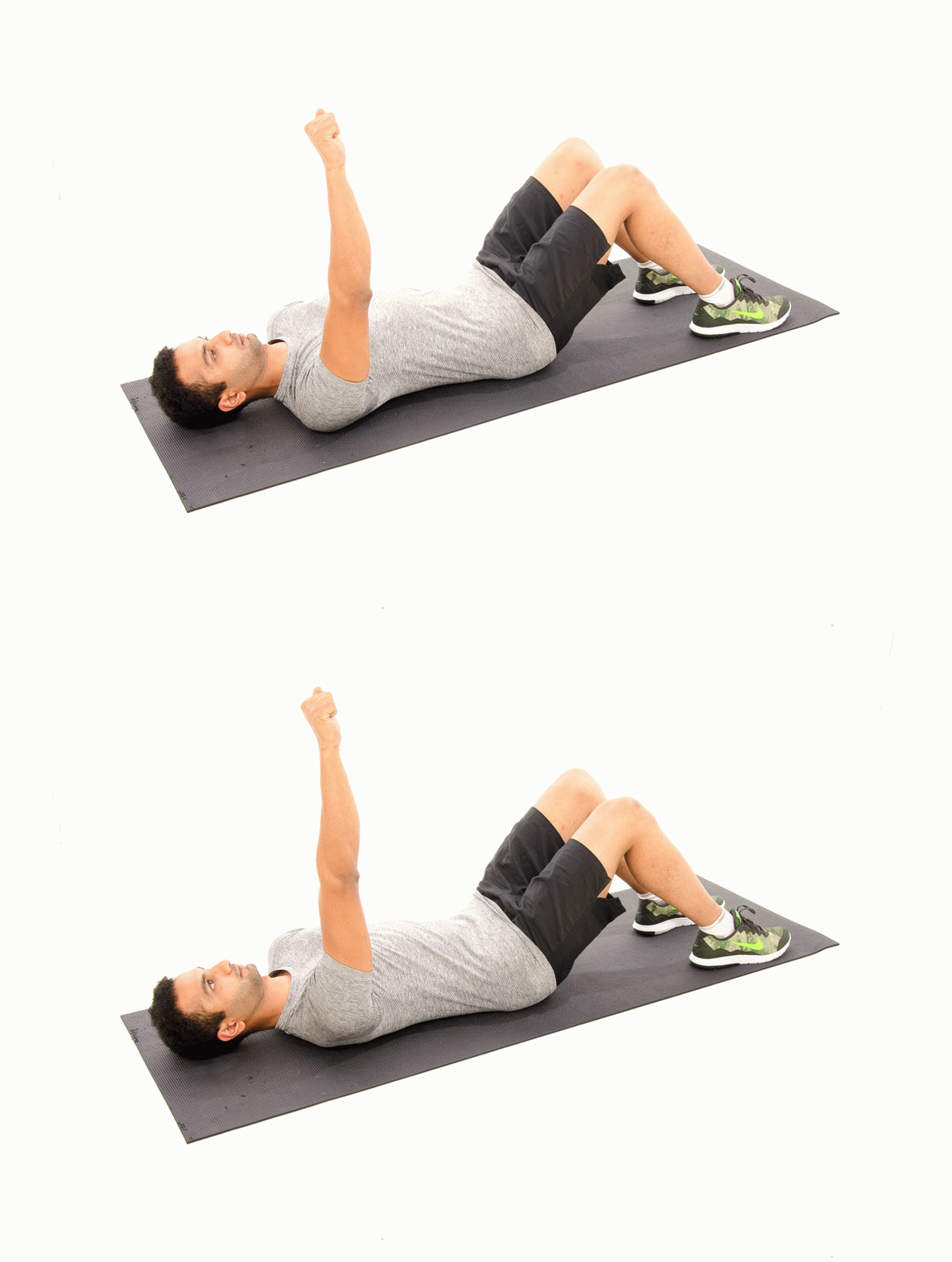
We begin in a supine position lying flat on your back. This eliminates the need to self-support your body weight or fight full gravity. You work on basic range of motion and motor control without stressing your weak stabilisers.
Exercise Example: Perform supine scapular punches. Lie flat with your arms extended straight toward the ceiling and reach your fists upward by peeling your shoulder blades off the floor.
Phase Two: Supine 90/90 and Deadbug Positions
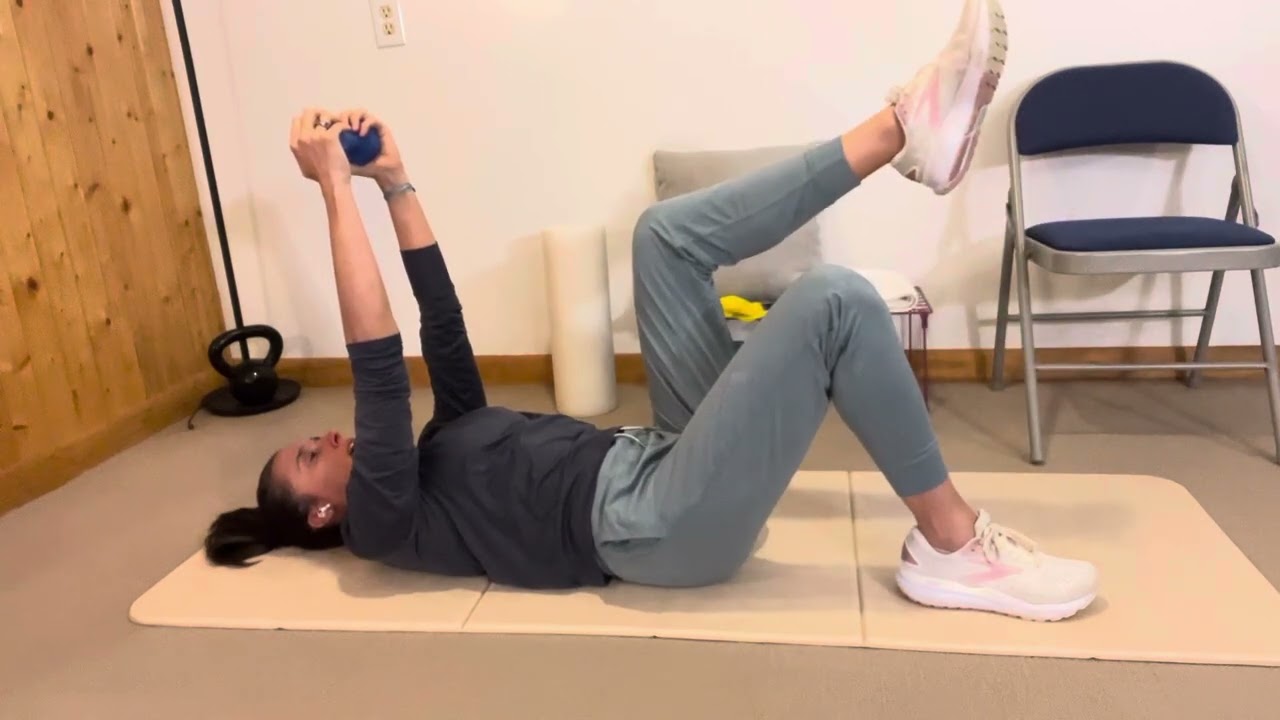
We progress to supine 90/90 or deadbug positions once your basic control improves. These variations demand integrated core and lower limb involvement. Engaging your core anchors your ribcage and provides a stable platform for your shoulder blade.
Exercise Example: Try a modified deadbug with a serratus reach. Lie in a 90/90 position with arms extended up and actively reach your opposite arm toward the ceiling as your leg extends.
Phase Three: Quadruped Position
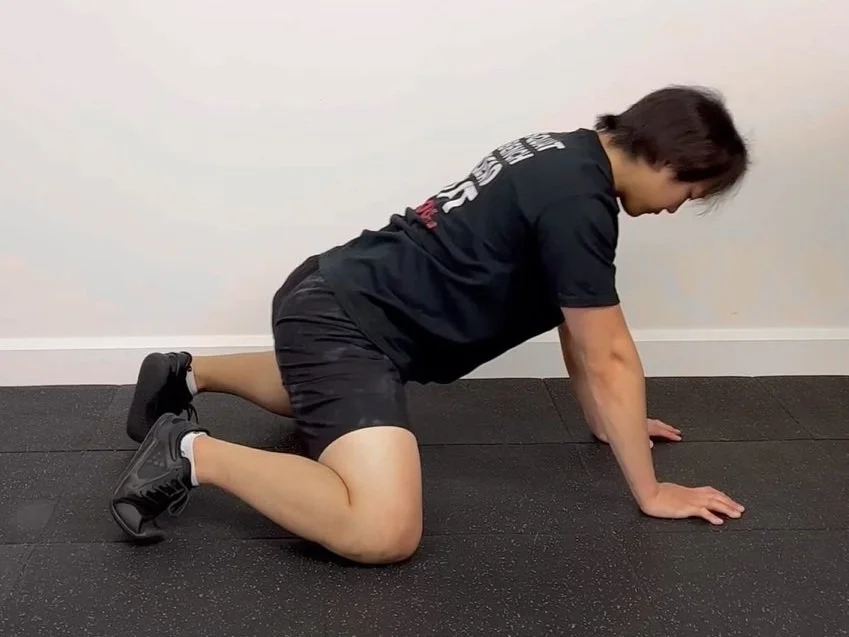
We transition to a quadruped or four-point kneeling position as your neuromuscular control solidifies. Loading your shoulder girdle on your hands and knees introduces a closed-chain gravitational load that forces your serratus anterior to engage.
Exercise Example: Perform quadruped rockbacks. On your hands and knees with locked elbows, let your chest sag slightly toward the floor before actively pushing the floor away.
Phase Four: Kneeling and Sitting
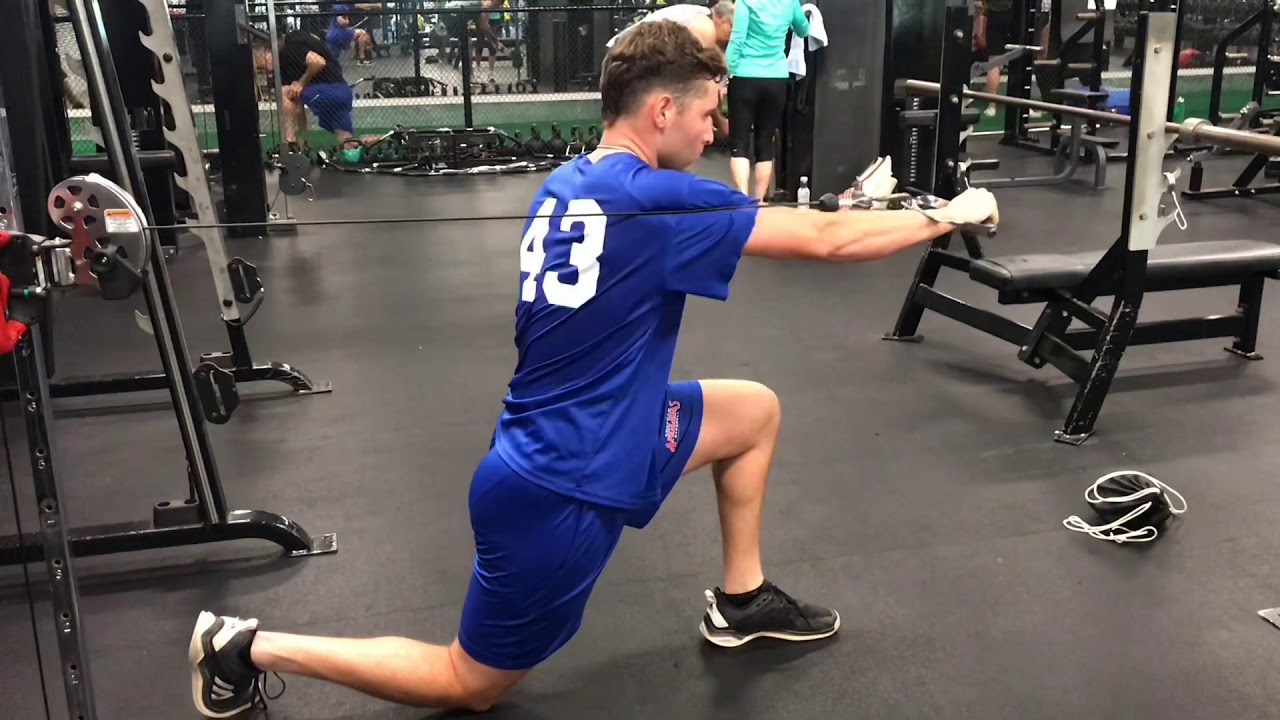
We progress vertically into kneeling and sitting positions. This step increases postural and anti-gravity demands on your spine while keeping your lower body anchored so you refine control without standing balance issues.
Exercise Example: Execute a half-kneeling cable press. In a half-kneeling position, press a cable or band forward to challenge your core and maintain scapular control.
Phase Five: Standing Upright
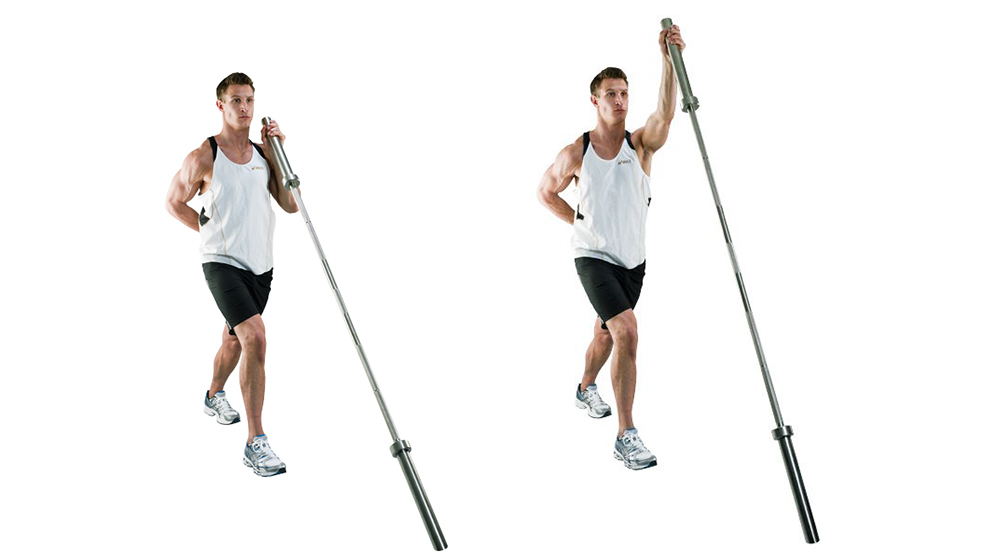
You graduate to loaded functional movements in a standing position. This fully integrates your new scapular mechanics into upright real-world tasks.
Exercise Example: Perform a standing landmine press. Stand in an athletic stance and press a barbell anchored in a landmine attachment diagonally upward and forward.
Rehab Environment Comparison for Scapular Winging
Choosing the right equipment for scapular rehabilitation dictates how effectively you can reload weak stabiliser muscles without aggravating upper trapezius dominance or mid back strain. Exercises for rehab can be done at home with free weights and resistance bands or at rehabilitation clinic with Clinical Pilates apparatus.
| Feature | Home Band and Dumbbell Drills | Specialised Pilates Apparatus |
|---|---|---|
| Resistance Profile | Unidirectional gravity or linear band tension | Multi-planar spring resistance with continuous feedback |
| Joint Loading | Direct axial loading or unassisted open chain force | Centrating compression and active tensile distraction |
| Guided Vectors | Free space movement relying entirely on self-control | Guided movement on reformer providing structural paths |
| Rehab Environment | Self-directed general conditioning | Real-time clinical modification and precise progression |
How Square One Active Recovery Can Help
Scapular winging and persistent shoulder pain can make daily reaching, lifting, and posture exhausting. In chronic cases, instability becomes part of everyday life, leading many individuals to give up on physical activities, sports, or gym workouts. Even when avoiding high-risk movements, upper trapezius fatigue and mid back strain can remain a constant daily occurrence.
At Square One Active Recovery, our clinical approach helps you move past structural frustration and rebuild active joint resilience. We systematically progress you from unloaded supine positions to advanced 3-dimensional loading, ensuring your shoulder blade develops the dynamic strength and neuromuscular control needed for full recovery.
Nobody else can decide when it is time to fix your shoulder, but when you are ready to reclaim your physical independence, professional services are available to support you every step of the way.
Ready to restore your shoulder stability and movement confidence? Book a comprehensive clinical assessment with Square One Active Recovery today.
Key Takeaways
When addressing scapular winging, shoulder pain, and muscular compensations, keep these core principles in mind:
-
1
Active neuromuscular retraining over passive care. Overcoming winging requires targeting the serratus anterior and restoring force couples rather than relying solely on manual massage or temporary tension relief.
-
2
Developmental progression builds foundational control. Starting unloaded in supine positions and advancing through quadruped and upright loading ensures weak stabilisers can adapt without triggering upper trapezius overload.
-
3
Specialised spring resistance optimises joint mechanics. Multi-planar spring feedback and guided tracks provide superior control compared to free-weight band drills when rebuilding long-term scapular stability.

