
If you have ever dealt with a persistent aching pain right between your shoulder blades, you already know how frustrating it can be. In clinical practice, shoulder blade pain is notorious for being slow to resolve and prone to returning.
When you consider the lifestyle in Singapore with long desk hours in the central business district, commuter stress, and high rates of postural strain, treating scapular pain becomes an even greater puzzle.
At Square One Active Recovery, our approach focuses on understanding why the shoulder blade is biomechanically complex and how active exercise helps you build long term physical resilience.
Why Is Shoulder Blade Pain So Stubborn? The 17-Muscle Anatomy Problem
Shoulder blade pain is notoriously stubborn to treat because the scapula is not a simple hinge joint. Instead, it functions as a major hub where 17 different muscles originate and insert.
Because so many overlapping superficial and deep muscle groups converge on this single bone, pain signals rarely come from just one isolated spot. When a single muscle fatigues or goes into spasm, it alters tension across the entire region. This creates a widespread web of discomfort that is tough to pinpoint and difficult to calm down with passive stretching alone.
This anatomical reality explains why quick fixes like foam rolling or a standard massage often leave you feeling frustrated. When you spend long hours working at a desk, these 17 muscles are caught in a constant state of low level tension. Relieving upper back discomfort requires understanding how this entire muscle network coordinates under daily loads rather than simply trying to rub out a single stubborn knot.
Why is scapular stability so difficult to achieve?
Unlike the forearm or the shin, the scapula operates as a floating bone with no direct bony connection to the spine or rib cage. The shoulder blade joints to your axial skeleton via a small joint at the collarbone. Because of this unique anatomy, the floating scapula glides across the ribcage entirely through muscular suspension. The main dynamic stabilisers holding it in place are the serratus anterior and the trapezius muscles.
Instead, it glides across the ribcage entirely through muscular suspension. The main dynamic stabilisers holding it in place are the serratus anterior and the trapezius muscles.
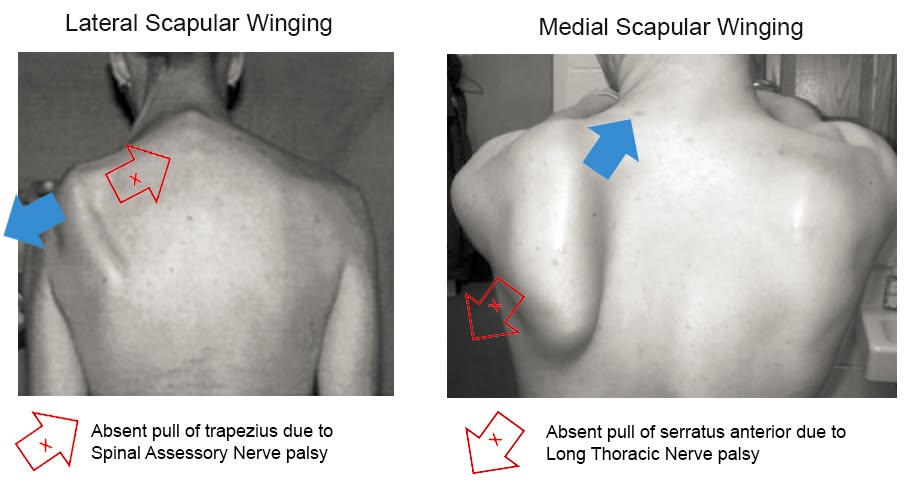
If the serratus anterior fails to anchor the inner border against the ribs, you experience medial scapular winging. If the trapezius fails to rotate the blade, the mechanical rhythm collapses.
What are the considerations in shoulder blade stabilisation training?
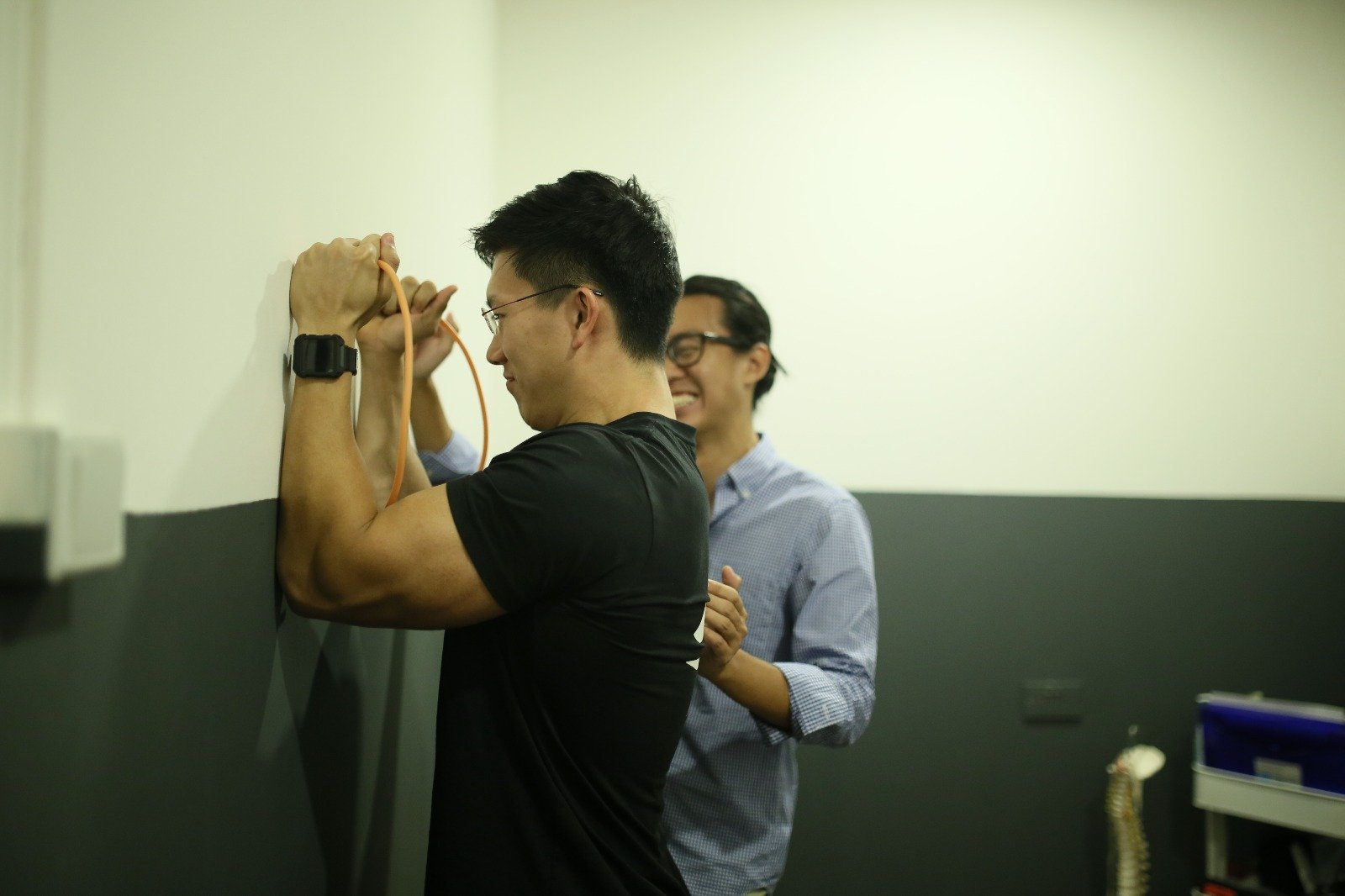
Because the shoulder blade relies entirely on muscular coordination rather than rigid joint structures to stay stable, restoring normal movement requires retraining motor control rather than just doing light isolation exercises. While wall slides can help you passively cue the shoulder blades onto the rib cage, static isolation only tells part of the story. Testing the dynamic stability of the scapula under load and compound movement is far more critical.
This is why we sometimes use barbell back squats in our clinic to test scapular integrity. When you step under a heavy barbell, your upper back and scapular complex must lock down to create a stable shelf. If control falters under axial load, your upper back rounds and compensation spreads across the body. Recovery often involves exercises that test how your shoulder blade behaves when your whole body works under heavy loads.
How Daily Reaching and Lifting Can Cause Shoulder Blade Strain
To make matters more difficult, the scapula cannot focus solely on its own stability. It acts as the dynamic base of support for your entire upper limb via the shoulder joint.
Every time you reach for a coffee, lift an object, or type on your laptop, the muscles surrounding your scapula must simultaneously stabilise the shoulder blade against the ribcage and provide a steady platform so your rotator cuff can move your arm smoothly through space.
When you experience shoulder or arm fatigue, your scapular muscles work double shifts. Over time, this constant multitasking leads to localised overload, micro trauma, and deep aching fatigue.
At a Glance: How Your Daily Life Can Strain Your Upper Back
Different daily and gym activities place unique biomechanical demands on your shoulder blade. Understanding these demands helps explain why upper back fatigue builds up so quickly.
| Common Activity | Scapular Movement Demanded | Why Fatigue or Pain Develops |
|---|---|---|
| Prolonged Desk Work | Sustained protraction and rounded shoulder posture | Constant low level strain without adequate breaks or movement variation |
| Reaching Overhead | Upward rotation, posterior tilt, and elevation | Poor mid back mobility forces local shoulder muscles to overwork |
| Heavy Barbell Lifting | Rigid retraction and absolute axial stability | Inadequate upper back tissue capacity and poor load distribution |
Why Limited Shoulder Blade Mobility Causes Upper Back Strain
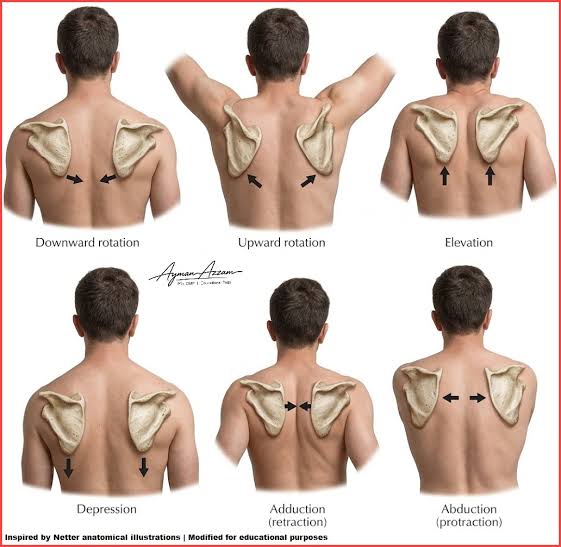
Functionally, the shoulder blade is one of the most mobile segments in the human body. It operates across six distinct directions of movement including elevation and depression, protraction and retraction, upward and downward rotation, plus anterior and posterior tilt.
Because it moves in so many planes simultaneously, any subtle restriction in just one direction, such as a lack of posterior tilt or limited upward rotation, throws off your entire kinetic chain.
How Mid Back Stiffness and Thoracic Posture Cause Upper Back Pain
Because your shoulder blade rides directly on top of your ribcage, its movement path depends entirely on what happens underneath it. If your mid back or thoracic spine is stiff, locked into flexion, or lacking rotational capacity, which is a common trademark of desk bound office life, the underlying track changes shape.
When thoracic extension and rotation are restricted, your shoulder blade is forced to move over a flat or rounded cage rather than a mobile curve. This bottleneck forces local scapular muscles to overwork to compensate for a lack of mid back movement, making any attempts to stretch or strengthen the scapula feel like an uphill battle until you restore mid back mobility.
How Spinal Curvature and Scoliosis Affect Shoulder Blade Recovery
In clinical rehabilitation, your recovery timeline can also be influenced by underlying structural variations such as scoliosis.
When a person has a spinal curvature, the geometric foundation upon which the scapula sits is altered. One side of the ribcage may protrude more than the other, causing asymmetric muscle lengths, uneven force distribution, and chronic imbalances in how the shoulder blade glides. Treating just the shoulder pain without addressing the spinal asymmetry leads to temporary relief at best, resulting in a frustrating cycle of recurring pain.
Uderstanding Scapular Winging and Active Neuromuscular Control
When the stabilisation of the shoulder blade breaks down, you may experience scapular winging where the medial (inner) border or inferior angle of the scapula lifts and protrudes away from the rib cage.
For most people, winging is typically a functional breakdown in neuromuscular control. It most commonly stems from weakness or inhibition of the serratus anterior and lower trapezius muscles, which fail to suction and upwardly rotate the scapula against the thoracic wall during movement. This disrupts the scapulothoracic force couple, leading to severe energy leaks during overhead reaching, pushing, or heavy lifting.
Because passive therapies like massage or stretching cannot rebuild motor recruitment patterns, resolving scapular winging requires structured, developmental reloading. By progressing from unloaded positional control (like supine protraction) to closed-chain axial loading and standing compound movements, you re-establish serratus anterior firing, restore joint rhythm, and rebuild true overhead capacity.
How to Find Lasting Relief from Stubborn Shoulder Blade Pain
Because your shoulder blade is a complex hub influenced by intricate biomechanics, multiple movement planes, mid back stiffness, and individual skeletal structures, standard passive treatments like simple stretching, heat packs, or routine massage often fall short.
True, lasting relief requires moving away from temporary symptom management and toward active motor control, targeted tissue loading, and progressive movement retraining. By systematically rebuilding how your scapula stabilises under heavy loads, unlocking thoracic mobility, and optimising its interaction with the rest of your body, you can restore true physical capacity and finally break the cycle of recurring upper back pain.
At Square One Active Recovery, we bridge the gap between clinical rehabilitation and long term physical performance. We integrate targeted active rehabilitation, clinical pilates, and progressive strength training to help you master deep motor control and build robust upper back capacity. You can achieve true physical independence and be pain-free without relying on endless passive treatments.
Key Takeaways
Keep these essential principles in mind when addressing persistent scapular pain:
-
1
Active Recovery Focus: True care empowers you with movement capacity and strength rather than trapping you in an endless cycle of passive treatments.
-
2
Unlock the Thoracic Spine: Mid back stiffness forces your shoulder blade to overwork, making spinal mobility a crucial step in recovery.
-
3
Build Real Capacity: Progressive exercise loading under compound movements helps you achieve lasting relief and self reliance.

